
Category: MCST council

  • Fix the process, not the people

    Work request to work order completion in days, not months

    When things go south in an MCST, the council usually changes the managing agent. They start afresh with a new one.

    Why changing your managing agent doesn’t fix your MCST

    Everything starts out well. The building manager is on the ball. Inspections happen regularly. Work requests get a quick response. The council hears from the BM often. Everyone is happy.

    Then familiarity sets in. Standards slip.

    Common MCST management problems after the honeymoon period

    Work requests get delayed or ignored. Some get priority just because the owner sits on the council. The BM signs off without checking if the work is done. Vendors carry out work above the threshold amount, with no formal approval from the majority of voters.

    Residents start to feel targeted. They are told they can’t do something that their neighbours get away with. When issues aren’t settled quickly, the frustration builds. It then turns on the managing agent, or on neighbours.

    Eventually the council changes the managing agent again. The cycle repeats. Only the actors are new. The plot is the same.

    What 50 Singapore MCSTs taught us about estate management

    At Basementgrid, we have studied over 50 MCSTs. What we found is consistent. Changing the people doesn’t solve the problem. It just passes it to the next council and the next managing agent.

    So we built an app to fix the process first. We borrowed from how corporations work. A process keeps things moving. Within it, each person still has room to use their judgment.

    Why an MCST needs a process: there is no founder or CEO

    A company has a founder or a CEO. This person holds the vision and the know-how. Even when staff change, the way of working stays.

    An MCST has no such person. The council changes every year or two. Each new committee starts from zero. Whatever the last council knew often leaves with them.

    That is why an MCST needs a process. The process holds the knowledge. It lets the estate be managed properly day to day. It also lets the estate be handed over easily to the next committee.

    MCST handover: developers hand over the estate, not the process

    The first MCST is created by the developer. At that point, the developer’s job is to hand the estate over to the residents. Whether a management process exists is not their concern.

    So the first council inherits a building with no playbook. They have to work it out as they go.

    Basementgrid gives developers a way to change that. We provide the guidelines for managing estate maintenance, built into an app. The developer hands over the estate with a working process already in place.

    Is the managing agent responsible for improving the process?

    You might think so. It seems reasonable that the managing agent should put the process in place.

    In most cases we have seen, that doesn’t happen. The managing agent is contracted to manage. They come in to do the management part. Improving the way things are done is rarely part of the scope, so it gets overlooked.

    A corporation works differently. Employees are part of the company. They suggest ways to improve the workplace and the process. They have a stake in how things run.

    A contracted party has a different mindset. The same goes for most vendors. They focus on delivering the service. They feel they are paid for what they do, and nothing more.

    So the initiative has to come from someone else. Council members are the natural choice. It is their estate. If they want it run better, they can make the change themselves.

    Report a fault on Basementgrid

    Estate maintenance app for MCSTs: Basementgrid vs iCondo

    iCondo focuses on community, with facility bookings and visitor management. Basementgrid digitalises the estate maintenance process. Every job is tracked and recorded. Responsibilities are clear. If something is delayed or mismanaged, you can trace it back through an immutable activity log.

    Setup takes about 3 minutes. Each role has the minimum it needs to do. Work orders are created and completed by different roles, so no one person controls the whole job.

    MCST management for volunteer councils and small managing agent teams

    We also kept the reality of MCSTs in mind. Council members are volunteers. A managing agent is often just one or two people running an estate of over 500 residents. So Basementgrid has built-in reminders and deadlines. Work doesn’t fall behind quietly. When delays happen, they are on record.

    Council members: fix your estate’s process now

    Don’t wait for the next managing agent to slip. Don’t wait for the next complaint to reach your inbox.

    The estate is yours. The process is yours to set up. And the sooner it’s in place, the easier the next handover will be.

    Here is how to start:

    1. Pick one recurring problem. It could be delayed work requests, or vendor work done without approval.
    2. Raise it at your next council meeting.
    3. Set up Basementgrid in 3 minutes and run that one process through the app.

    You don’t need to change anyone. You only need to change how the work gets done.
    Start with Basementgrid today →

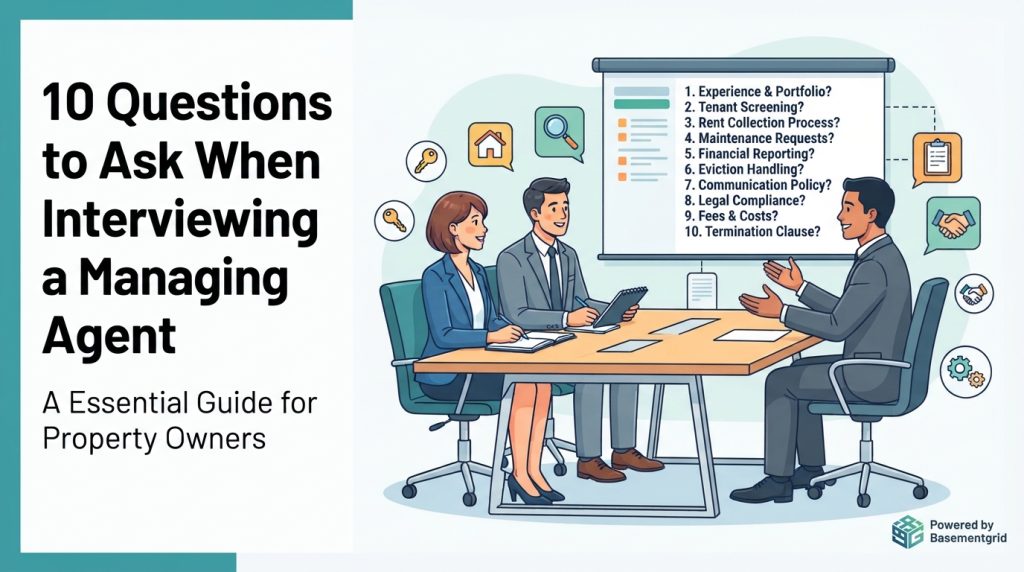
  • 10 Questions to Ask When Interviewing a Managing Agent

    Managing Agent Checklist

    Hiring a managing agent (MA) is a bit like hiring for a job. You wouldn’t pick a candidate without asking questions and comparing answers, and the same goes for your MA. Price and past work usually carry the most weight, so they are on the list. But many councils stop there and choose after a short chat, then find out the gaps later.

    Council members are volunteers. Most of you have a day job, and few have ever interviewed an MA. Without a way to compare, the decision tends to come down to feel: who was friendlier, who spoke more confidently, who the last council used. A score gives you a more objective way to evaluate each prospect. It also gives the council something to point to when the members disagree.

    A score also helps when owners ask why you picked a particular MA. Some will question the choice, and “we felt they were the best” is a hard answer to defend. If you can show the questions you asked and the scores each MA got, you can tell subsidiary proprietors (SPs) that the decision was objective and not based on personal preference. Even owners who disagree can see how the council reached it.

    We’ve put together 10 questions you can ask each shortlisted MA. Rate each answer out of 10 and add up the score. Maximum is 100. Download the printable checklist (PDF) and bring it to the meeting.

    The questions

    1. Which similar estates do you manage, and can we speak to two of their council members? Which estates left you in the last 2 years, and why?
    2. What is your total fee, what does it cover, and what costs extra (for example AGM, EGM or extra site visits)?
    3. How do you track maintenance work and follow up on requests? What can the council see, and what is your usual turnaround?
    4. How do you check that completed work meets the spec, and who signs it off?
    5. What would you do differently from our previous MA? Please give an example.
    6. How do you plan long-term works, such as repainting or lift upgrades, and advise on the sinking fund?
    7. How do you handle an SP’s request or complaint from start to close? Who replies, and when?
    8. Who will be our building manager, and who covers when they are away? How do you evaluate them, and what if they underperform?
    9. How do you choose and evaluate vendors? Do you have any commercial relationship with them, and what if one underperforms?
    10. How and how often do you report to the council, and how do we get our records if we change MA?

    How to score

    Give 0 to 3 for a vague or generic answer, 4 to 6 for a reasonable answer with no example, and 7 to 10 for a clear process backed by a real example or evidence. If the MA can only say “we take it seriously”, that’s a 3.

    Have every council member at the meeting score separately, then compare. If two members score the same answer very differently, that’s worth a short discussion before you decide. The total won’t make the decision for you, but it will show you where the MAs really differ.

    Tips for running an MA interview

    Send the questions to each MA a few days before the meeting so they can prepare. Ask every MA the same questions in the same order. If the questions change from one interview to the next, the scores can’t be compared fairly.

    Ask for an example whenever an answer sounds general. “Can you tell us about a recent case?” is usually enough.

    Write notes on the checklist as you go, and score straight after each interview. If you wait until the end of the day, the MAs start to blur together and the first and last ones are remembered best.

    After the interviews

    Add up the totals and look at where the scores differ the most. A big gap on one question is often more useful than a small gap in the total. Call the references the MAs gave you and ask them the same questions.

    Keep the filled-in checklists. When owners ask how the decision was made, you can show them the questions, the scores and the reasons.

  • The Light Stayed Broken for 3 Weeks. Then a Council Member Mentioned It.

    Daniel is a made-up owner, but if you’ve lived in a condo for a few years, you probably know him.

    Daniel’s corridor light had been flickering for three weeks. He’d reported it to the MA twice and got “noted” both times. Then his neighbour, who sits on the MCST council, mentioned it in passing, and the electrician showed up two days later.

    Daniel noticed that. Council members get answered faster, because the MA reports to the council. Work requests get looked at, the guards pay attention, and a dispute with a neighbour gets taken seriously.

    So when the AGM came around and someone asked for volunteers, he thought about putting his name down. Then he thought about everything he’d heard. The meetings are at night and run for hours. Every decision upsets someone. A neighbour who didn’t get his way may write nasty messages in the estate chat, and a few estates have even ended up in court. He kept his hand down. Most owners do the same.

    Here’s how it could have gone if Daniel had joined and the work lived in an app.

    The council meetings. Instead of booking the function room every month, the council meets on Zoom for the things that need discussion. Quotes and payments that used to wait for a meeting get approved in Basementgrid whenever Daniel has a minute, like on the MRT. The call is recorded, an AI tool drafts the minutes from the transcript, and the secretary signs off. The meetings get shorter and happen less often.

    MCST council meetings

    The money. Daniel’s biggest worry was signing off on something he didn’t fully understand. So the council sets the approval threshold to zero. The MA can’t start any job until the council pre-approves it on Basementgrid. Payment goes through a QR code generated by Basementgrid, tied to the approved amount and the vendor’s UEN, so the amount and the payee can’t change after approval.

    The proof. Before a payment, he doesn’t have to take anyone’s word that the job was done. The vendor clocks in with GPS verification and submits photos taken at the location, with no uploads from the photo library. The BM reviews the work and accepts it before the payment goes out.

    The neighbours. Remember the flickering light? Residents can now report faults themselves in Basementgrid, a bit like the OneService app for HDB estates. Every report is time-stamped, so nothing depends on someone remembering to pass it on. If a job stalls, Daniel can see where it’s stuck and who’s holding it up, and he can ask about it without guessing.

    The quotes. Two quotes for the same lift repair arrive, and they don’t line up. One lists parts and labour separately, and the other has a single lump sum. The AI quote check (coming soon) summarises each quote and flags the items worth questioning. Daniel still makes the call, but he’s no longer comparing apples to oranges by himself.

    The backlash. Eventually a neighbour complains, as one always does. This time Daniel doesn’t have to rely on his memory of a meeting eight months ago. The record shows who approved the job, when, which quote it was based on, and what proof of work came back. He can reply with facts. Some people will still be unhappy, but he isn’t defending himself from scratch.

    Being on the council still takes time, and you’ll still make calls that not everyone likes. But much of the tracking, chasing, and record keeping that made the role feel thankless can now sit in an app. These days you can book a ride or a stay from your sofa because startups took over the tedious parts. Hopefully Basementgrid can join that list, so you can manage your estate from your phone.


    Try it on one work order

    Daniel is made up, but the setup is real. A council member or building manager can create a workspace in about 3 minutes by setting the approval threshold and inviting the other council members. After that, run one work order from start to finish with a vendor you already use, and see how it feels before changing anything else.

    Fix the process, not the people.