Building Smarter Communities

Expert insights on compliance, workflow efficiency, and modern estate management built for Singapore property councils.

  • Fix the process, not the people

    Work request to work order completion in days, not months

    When things go south in an MCST, the council usually changes the managing agent. They start afresh with a new one.

    Why changing your managing agent doesn’t fix your MCST

    Everything starts out well. The building manager is on the ball. Inspections happen regularly. Work requests get a quick response. The council hears from the BM often. Everyone is happy.

    Then familiarity sets in. Standards slip.

    Common MCST management problems after the honeymoon period

    Work requests get delayed or ignored. Some get priority just because the owner sits on the council. The BM signs off without checking if the work is done. Vendors carry out work above the threshold amount, with no formal approval from the majority of voters.

    Residents start to feel targeted. They are told they can’t do something that their neighbours get away with. When issues aren’t settled quickly, the frustration builds. It then turns on the managing agent, or on neighbours.

    Eventually the council changes the managing agent again. The cycle repeats. Only the actors are new. The plot is the same.

    What 50 Singapore MCSTs taught us about estate management

    At Basementgrid, we have studied over 50 MCSTs. What we found is consistent. Changing the people doesn’t solve the problem. It just passes it to the next council and the next managing agent.

    So we built an app to fix the process first. We borrowed from how corporations work. A process keeps things moving. Within it, each person still has room to use their judgment.

    Why an MCST needs a process: there is no founder or CEO

    A company has a founder or a CEO. This person holds the vision and the know-how. Even when staff change, the way of working stays.

    An MCST has no such person. The council changes every year or two. Each new committee starts from zero. Whatever the last council knew often leaves with them.

    That is why an MCST needs a process. The process holds the knowledge. It lets the estate be managed properly day to day. It also lets the estate be handed over easily to the next committee.

    MCST handover: developers hand over the estate, not the process

    The first MCST is created by the developer. At that point, the developer’s job is to hand the estate over to the residents. Whether a management process exists is not their concern.

    So the first council inherits a building with no playbook. They have to work it out as they go.

    Basementgrid gives developers a way to change that. We provide the guidelines for managing estate maintenance, built into an app. The developer hands over the estate with a working process already in place.

    Is the managing agent responsible for improving the process?

    You might think so. It seems reasonable that the managing agent should put the process in place.

    In most cases we have seen, that doesn’t happen. The managing agent is contracted to manage. They come in to do the management part. Improving the way things are done is rarely part of the scope, so it gets overlooked.

    A corporation works differently. Employees are part of the company. They suggest ways to improve the workplace and the process. They have a stake in how things run.

    A contracted party has a different mindset. The same goes for most vendors. They focus on delivering the service. They feel they are paid for what they do, and nothing more.

    So the initiative has to come from someone else. Council members are the natural choice. It is their estate. If they want it run better, they can make the change themselves.

    Report a fault on Basementgrid

    Estate maintenance app for MCSTs: Basementgrid vs iCondo

    iCondo focuses on community, with facility bookings and visitor management. Basementgrid digitalises the estate maintenance process. Every job is tracked and recorded. Responsibilities are clear. If something is delayed or mismanaged, you can trace it back through an immutable activity log.

    Setup takes about 3 minutes. Each role has the minimum it needs to do. Work orders are created and completed by different roles, so no one person controls the whole job.

    MCST management for volunteer councils and small managing agent teams

    We also kept the reality of MCSTs in mind. Council members are volunteers. A managing agent is often just one or two people running an estate of over 500 residents. So Basementgrid has built-in reminders and deadlines. Work doesn’t fall behind quietly. When delays happen, they are on record.

    Council members: fix your estate’s process now

    Don’t wait for the next managing agent to slip. Don’t wait for the next complaint to reach your inbox.

    The estate is yours. The process is yours to set up. And the sooner it’s in place, the easier the next handover will be.

    Here is how to start:

    1. Pick one recurring problem. It could be delayed work requests, or vendor work done without approval.
    2. Raise it at your next council meeting.
    3. Set up Basementgrid in 3 minutes and run that one process through the app.

    You don’t need to change anyone. You only need to change how the work gets done.

    Start with Basementgrid today →

  • Where Did the Money Go? Your Work Order Should Know

    A work order that only records what, where and how a job was done isn’t much use. It’s just a document. So we made the work order do more: approvals, proof of work and payments all happen inside it.

    Who Approved This Spending?

    Work Order Approval MCST

    Many MCSTs need a majority vote before spending above a certain amount. Owners contribute to the maintenance fund every month, and they scrutinise how it’s used. Every dollar needs a proper record, or owners will get upset when they find out about misuse.

    On Basementgrid, a work order is only issued to the vendor once the required votes are in.

    There’s one catch. If no work order is created, the approval step is bypassed, and no software can record spending that never entered the system. That’s why we built payment into the app as well.

    How Was It Paid?

    PayNow QR code Vendor Payment

    We looked at how most organisations actually pay, and built a Billing stage around it. Vendors upload their invoice to the matching work order. From there, you can either:

    • pay directly from the app, using a unique PayNow QR code that carries the work order amount and the vendor’s UEN, and scan it in your bank app, or
    • download the maintenance ledger, tap the work order link to check the proof of work, then have the accounts team make a batch payment.

    Either way, the work order exists and the approvals are logged, so the spending is accounted for. It isn’t a pile of WhatsApp screenshots and emails pieced together by managers after the fact.

    To complete the Billing stage, the payer updates the record or the manager marks the work order as paid. That updates the maintenance ledger, which is what you’ll rely on for audits later.

    Was the Work Actually Done?

    Proof of work is submitted in the app and kept permanently in the cloud, so it’s accessible to everyone involved. It doesn’t sit in one person’s WhatsApp chat or email inbox. Each submission is GPS verified and timestamped, so you can show subsidiary proprietors (SPs) that the work was completed on site within a particular period.

    Looking after your estate’s maintenance doesn’t need you at a desk anymore. You can do it from your couch, or on the MRT between everything else on your schedule.


    Not sure how your MCST handles this today? Book a demo and we’ll help you work out where the gaps are.

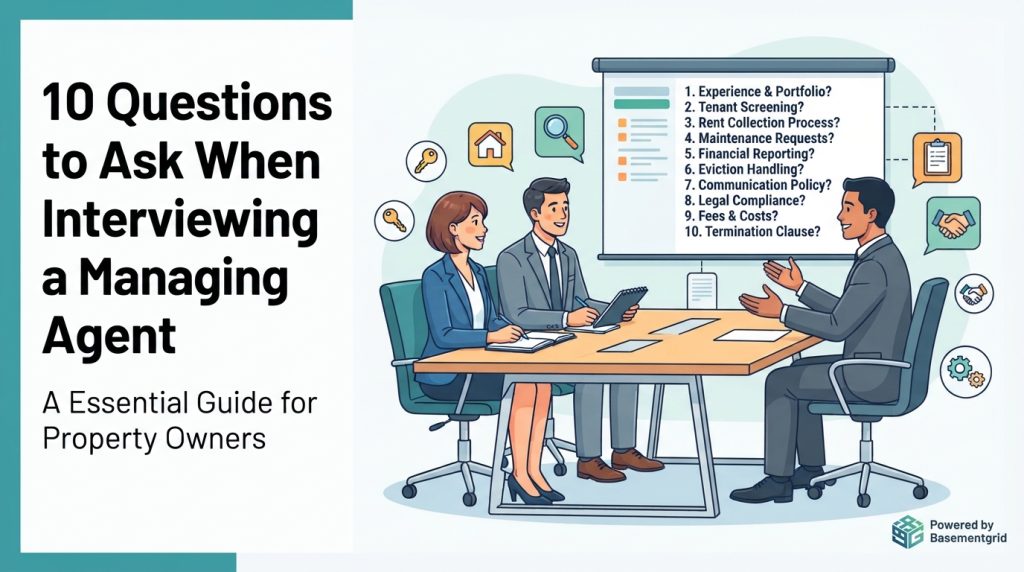
  • 10 Questions to Ask When Interviewing a Managing Agent

    Managing Agent Checklist

    Hiring a managing agent (MA) is a bit like hiring for a job. You wouldn’t pick a candidate without asking questions and comparing answers, and the same goes for your MA. Price and past work usually carry the most weight, so they are on the list. But many councils stop there and choose after a short chat, then find out the gaps later.

    Council members are volunteers. Most of you have a day job, and few have ever interviewed an MA. Without a way to compare, the decision tends to come down to feel: who was friendlier, who spoke more confidently, who the last council used. A score gives you a more objective way to evaluate each prospect. It also gives the council something to point to when the members disagree.

    A score also helps when owners ask why you picked a particular MA. Some will question the choice, and “we felt they were the best” is a hard answer to defend. If you can show the questions you asked and the scores each MA got, you can tell subsidiary proprietors (SPs) that the decision was objective and not based on personal preference. Even owners who disagree can see how the council reached it.

    We’ve put together 10 questions you can ask each shortlisted MA. Rate each answer out of 10 and add up the score. Maximum is 100. Download the printable checklist (PDF) and bring it to the meeting.

    The questions

    1. Which similar estates do you manage, and can we speak to two of their council members? Which estates left you in the last 2 years, and why?
    2. What is your total fee, what does it cover, and what costs extra (for example AGM, EGM or extra site visits)?
    3. How do you track maintenance work and follow up on requests? What can the council see, and what is your usual turnaround?
    4. How do you check that completed work meets the spec, and who signs it off?
    5. What would you do differently from our previous MA? Please give an example.
    6. How do you plan long-term works, such as repainting or lift upgrades, and advise on the sinking fund?
    7. How do you handle an SP’s request or complaint from start to close? Who replies, and when?
    8. Who will be our building manager, and who covers when they are away? How do you evaluate them, and what if they underperform?
    9. How do you choose and evaluate vendors? Do you have any commercial relationship with them, and what if one underperforms?
    10. How and how often do you report to the council, and how do we get our records if we change MA?

    How to score

    Give 0 to 3 for a vague or generic answer, 4 to 6 for a reasonable answer with no example, and 7 to 10 for a clear process backed by a real example or evidence. If the MA can only say “we take it seriously”, that’s a 3.

    Have every council member at the meeting score separately, then compare. If two members score the same answer very differently, that’s worth a short discussion before you decide. The total won’t make the decision for you, but it will show you where the MAs really differ.

    Tips for running an MA interview

    Send the questions to each MA a few days before the meeting so they can prepare. Ask every MA the same questions in the same order. If the questions change from one interview to the next, the scores can’t be compared fairly.

    Ask for an example whenever an answer sounds general. “Can you tell us about a recent case?” is usually enough.

    Write notes on the checklist as you go, and score straight after each interview. If you wait until the end of the day, the MAs start to blur together and the first and last ones are remembered best.

    After the interviews

    Add up the totals and look at where the scores differ the most. A big gap on one question is often more useful than a small gap in the total. Call the references the MAs gave you and ask them the same questions.

    Keep the filled-in checklists. When owners ask how the decision was made, you can show them the questions, the scores and the reasons.

  • Submit Quotation: How v2.5 Gets a Quote From Vendor to Work Order Without the Chasing

    Basementgrid v2.5

    Basementgrid v2.5 is out, and the main new feature is Submit Quotation. Vendors can now send their quote straight into the work order, and the approval that follows runs on its own. Please update your app to try it.

    First, a look at how a quotation usually works, because it explains why we built this.

    How it works today

    The vendor sends a quotation by email or WhatsApp. The BM can’t just forward it to the council, because nobody knows what it’s for. So he writes the background first: what broke, why this vendor, why this price. Then it goes to the council members for approval, and he waits for a majority to reply.

    When the work is done, he scans the vendor’s job sheet. He then sends the quotation, the job sheet and a screenshot or email of the council’s approval to the accountant, who creates the payment. After that the whole pile goes to the two approvers, usually the Treasurer and the Secretary, who approve the payment in the bank app.

    Every step is a forward, and every forward can sit in someone’s inbox for a week. When someone asks where it’s stuck, nobody can say.

    We had already turned most of this into a work order link, with timestamps and comments recorded in the app. In v2.5 the quotation itself moves into the work order too.

    What’s new in v2.5: Submit Quotation

    work order approval workflow

    The vendor now submits the quote directly in Basementgrid, with the amount entered in the system. The BM reviews it and taps Accept. If the amount is under the approval threshold, the work order goes out to the vendor straight away.

    If the amount is above the threshold, Basementgrid sends it to the council members for authorisation. The work order is only issued once the minimum number of approvals is met. The BM doesn’t forward anything or write a summary. The moment the council approves, the vendor gets the work order and can dispatch a technician.

    When council members don’t respond

    Most delays aren’t rejections. Someone just hasn’t got round to it. So Basementgrid follows up for you:

    • After 24 hours, it reminds the council members who haven’t approved.
    • After 48 hours, it reminds them again.
    • After 72 hours, it escalates to the BM.

    When the council says no

    The BM is told immediately. From there he has three options: ask the same vendor for a new quote, switch to another vendor, or enter the price himself and issue the work order. Nothing waits on a reply, and the activity log shows exactly where the job is stalled and with whom.

    After the approval: the rest of the job stays in the same work order

    Once the work order is issued, the vendor’s technician clocks in at the site, does the job and submits proof of work, including photos taken on the spot. The BM reviews it, and the vendor submits the invoice against the same work order. The approvers then pay using the PayNow QR code, which carries the invoice amount and the vendor’s UEN, and the payment is marked as paid. Nobody scans a job sheet or forwards a pile of documents to the accountant, because the quotation, approvals, proof of work and invoice are already in one place with their timestamps.

    Old way vs Basementgrid

    • The quote: It used to sit in an email or WhatsApp chat. Now the vendor enters the amount in the work order.
    • The background: The BM used to write the story behind the quote himself. Now the work order carries it, so there’s nothing to write up.
    • Approval: The BM used to forward the quote and chase council members one by one. Now Basementgrid sends it, reminds them at 24 and 48 hours, and escalates to the BM at 72 hours.
    • Records: There used to be a pile of scans, screenshots and forwarded emails. Now the quotation, approvals, proof of work and invoice sit in one work order with timestamps.
    • When it stalls: Nobody could say where it was stuck. Now the activity log shows exactly where.

    What’s next: creating a work order from a photo

    We’re not stopping at quotations. The next version uses AI to make creating a work order much faster.

    The BM takes a photo of the fault. The AI looks at it and suggests the title, the location and the asset for the work order. The BM checks the suggestions, fixes anything that’s off, and confirms. The work order is created and assigned to the vendor linked to that asset.

    Today, creating a work order means typing a title, picking a location, finding the asset and choosing a vendor. For a BM walking the estate with a dozen things to log, that adds up. With the photo, most of the form is filled in before he starts typing. The BM still has the final say, because every suggestion can be edited before the work order is issued.

    Update to v2.5

    Submit Quotation only works if the people on both sides of the quote are on the latest version. Building managers, council members and approvers, please update your app. Vendors, please update too, so you can submit your next quote directly in the work order.

    You can update from the App Store or Google Play, or get the app here: https://bgr.one/bxK80umibBb

    Fix the process, not the people.

  • The Light Stayed Broken for 3 Weeks. Then a Council Member Mentioned It.

    Daniel is a made-up owner, but if you’ve lived in a condo for a few years, you probably know him.

    Daniel’s corridor light had been flickering for three weeks. He’d reported it to the MA twice and got “noted” both times. Then his neighbour, who sits on the MCST council, mentioned it in passing, and the electrician showed up two days later.

    Daniel noticed that. Council members get answered faster, because the MA reports to the council. Work requests get looked at, the guards pay attention, and a dispute with a neighbour gets taken seriously.

    So when the AGM came around and someone asked for volunteers, he thought about putting his name down. Then he thought about everything he’d heard. The meetings are at night and run for hours. Every decision upsets someone. A neighbour who didn’t get his way may write nasty messages in the estate chat, and a few estates have even ended up in court. He kept his hand down. Most owners do the same.

    Here’s how it could have gone if Daniel had joined and the work lived in an app.

    The council meetings. Instead of booking the function room every month, the council meets on Zoom for the things that need discussion. Quotes and payments that used to wait for a meeting get approved in Basementgrid whenever Daniel has a minute, like on the MRT. The call is recorded, an AI tool drafts the minutes from the transcript, and the secretary signs off. The meetings get shorter and happen less often.

    MCST council meetings

    The money. Daniel’s biggest worry was signing off on something he didn’t fully understand. So the council sets the approval threshold to zero. The MA can’t start any job until the council pre-approves it on Basementgrid. Payment goes through a QR code generated by Basementgrid, tied to the approved amount and the vendor’s UEN, so the amount and the payee can’t change after approval.

    The proof. Before a payment, he doesn’t have to take anyone’s word that the job was done. The vendor clocks in with GPS verification and submits photos taken at the location, with no uploads from the photo library. The BM reviews the work and accepts it before the payment goes out.

    The neighbours. Remember the flickering light? Residents can now report faults themselves in Basementgrid, a bit like the OneService app for HDB estates. Every report is time-stamped, so nothing depends on someone remembering to pass it on. If a job stalls, Daniel can see where it’s stuck and who’s holding it up, and he can ask about it without guessing.

    The quotes. Two quotes for the same lift repair arrive, and they don’t line up. One lists parts and labour separately, and the other has a single lump sum. The AI quote check (coming soon) summarises each quote and flags the items worth questioning. Daniel still makes the call, but he’s no longer comparing apples to oranges by himself.

    The backlash. Eventually a neighbour complains, as one always does. This time Daniel doesn’t have to rely on his memory of a meeting eight months ago. The record shows who approved the job, when, which quote it was based on, and what proof of work came back. He can reply with facts. Some people will still be unhappy, but he isn’t defending himself from scratch.

    Being on the council still takes time, and you’ll still make calls that not everyone likes. But much of the tracking, chasing, and record keeping that made the role feel thankless can now sit in an app. These days you can book a ride or a stay from your sofa because startups took over the tedious parts. Hopefully Basementgrid can join that list, so you can manage your estate from your phone.


    Try it on one work order

    Daniel is made up, but the setup is real. A council member or building manager can create a workspace in about 3 minutes by setting the approval threshold and inviting the other council members. After that, run one work order from start to finish with a vendor you already use, and see how it feels before changing anything else.

    Fix the process, not the people.

  • Why MAs, Councils and Vendors Pull Apart, and What Keeps Them Together

    Why MAs, Councils and Vendors Pull Apart, and What Keeps Them Together

    In the last post I wrote about why estate management collaboration is a three-party problem: the MA, the council, and the vendors. Each party has its own organisation, its own priorities, and its own way of working.

    You could build a work order tool and make the BM’s life easier. You could build an invoice tool and make the vendor’s life easier. Each would work for the one party it was built for, but the problems from that post would still be there, because they sit between the parties, not inside any one of them.

    So we borrowed a playbook from how platforms work, and this is how we build Basementgrid.

    Start From the Destination, Not the Feature List

    We look at the final destination first, which is a job done properly and paid for. Then we choose the route and pick the actors involved. For each actor, we decide the minimum action they need to take at each stop. Then we plan the route with the fewest stops, and the required actions at each one.

    This isn’t about disturbing the usual process. The traditional flow was drawn up before PCs and mobile phones existed, and a lot of its steps are there because people have always done them that way. Some of those steps are work a phone can do for us now. Cutting stops means less disruption on the way to where everyone already wants to go.

    Three things shape how we decide who does what.

    1. Collaboration Starts by Cutting What Council Members and MAs Have to Do

    The honest truth is that many council and MA members are older, and attention and patience for software tends to be lower than for middle-aged users. They are also the minority on the council and MA side, so it’s almost impossible to ask them to learn a CMMS.

    So we cut what they have to do. Most processes have an AI suggestion and a one-tap action, and we shift the remaining work to the other parties, mainly the vendor manager and technician. The rule is less typing, more tapping. The AI does most of the data entry, and you do the checking.

    2. A Work Order Approval Process That Decides Once, Not Twice

    Take a common setup. The rules say a BM can issue a work order up to a certain amount, but a council member must approve the payment once the invoice comes in.

    If you’ve already set that rule, why approve the same job twice? On Basementgrid, setting the rule is the approval. The council authorises the payment up front, under the conditions they chose. A work order then works a bit like a smart contract. Once the BM has verified the work is done and the vendor has submitted the invoice, those conditions are met and the payment is already authorised. The approver just pays it in the bank app.

    This doesn’t take away the council’s say. If something looks dubious, the council can log their questions in the work order, or stop it before the BM verifies and accepts the work. What we remove is the second approval after everything has already checked out.

    I know some people won’t like this. “Your convenience isn’t everyone’s convenience” is something we say a lot. A process that works for all three parties will always ask someone to give up a habit. Uber didn’t ask taxi companies how they’d like to be disrupted, and we’re taking the same attitude to estate management.

    3. How to Get Vendors, Councils and Building Managers Working Together Without Training

    Every stakeholder belongs to a different organisation. Training doesn’t work, because nobody has an incentive to change how they do things unless they gain something from it. So each step in Basementgrid is pushed along by either a direct incentive or a guardrail.

    • Vendors: This is the simplest. If you want to get paid, follow the system. Show proof of work, submit your invoice, and get paid.
    • Council members: If there’s a red flag, you get notified. You approve works and pay without having to rely on someone else’s opinion.
    • Building managers: You save the paperwork and the time spent on documentation. It’s all in the app, and you only accept the work order once what you required has been submitted.

    Each party gets something in return for doing its part, and the system doesn’t move forward until the part is done.

    Where this leaves us

    None of this is a new idea in other industries. Platforms have worked this way for years. Estate management just hasn’t had one yet, and we’re building it.

    Fix the process, not the people.

  • Tripartite in Action: How Three Parties Get an Estate Maintained

    Tripartite in Action: How Three Parties Get an Estate Maintained

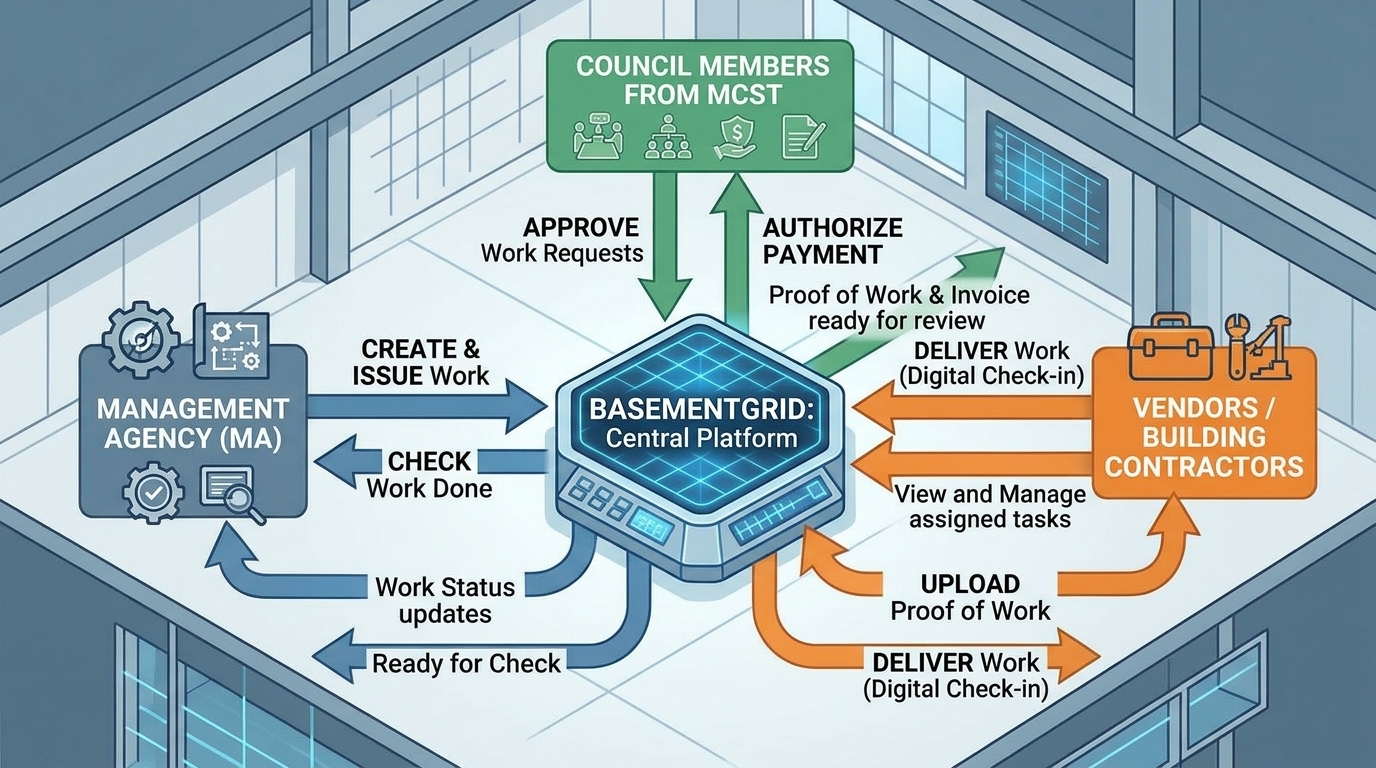
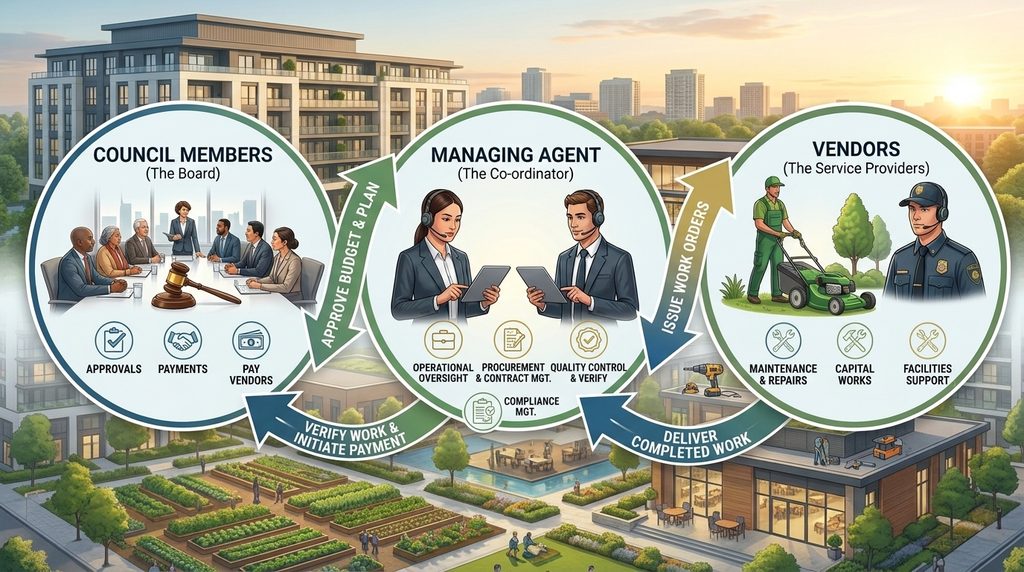
    Every MCST has the same three parties involved in getting a job done: the Managing Agent (MA), the council members, and the vendors. The MA coordinates, the council decides and approves the spending, and the vendor does the work. None of them can finish a job alone, and each one is waiting on the other two at some point.

    A Collaboration Tool for Estate Management, Not Just a Documentation Tool

    That’s why Basementgrid focuses on the actions each party has to take, and not only on documentation and record keeping. A fault gets reported, someone checks it, the vendor sends a quotation, the council approves, the work gets done, and the MA verifies it. Every step has an owner, and the app shows that person what they need to do next. We’re a collaboration tool first. The records are a result of people doing their part, not the goal.

    How an MCST Work Order Moves Between MA, Council and Vendor

    Take a leaking pipe in the basement carpark. The building manager logs the fault and does an initial check. The MA picks a vendor and asks for a quotation. The vendor sends it, linked to that fault check. The council reviews it with the photos and the evaluation in front of them, and approves. The vendor does the work and uploads proof from site. The MA verifies it and closes the job. Nobody has to dig through emails or scroll a chat group to find out where things stand.

    We went this way because of three problems we kept running into.

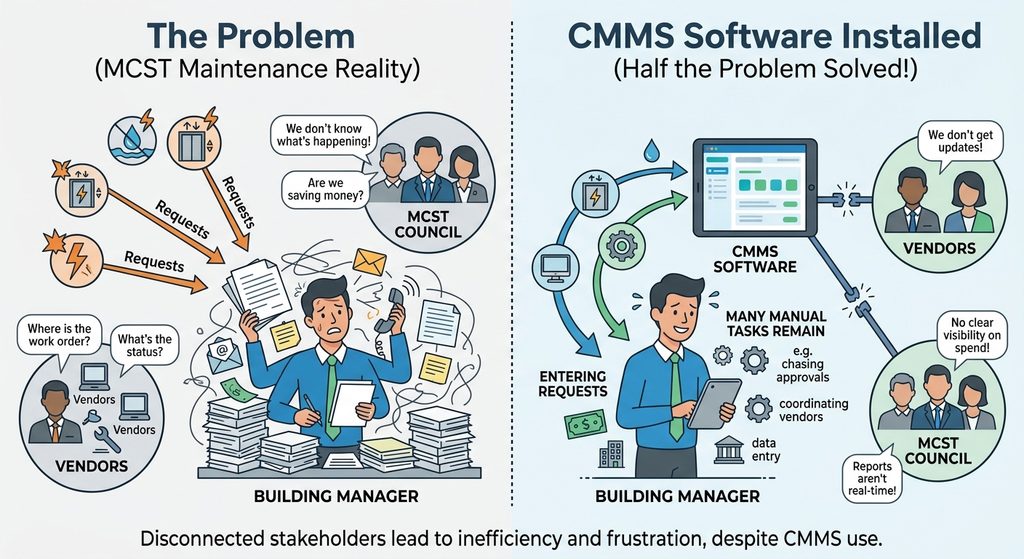
    Why CMMS Software Only Solves Half the Problem for MCSTs

    CMMS Software Limits

    Most of them are built for the MA, the building manager and an internal tech team. Very few MCSTs have the budget for an internal tech team. So the building manager ends up doing extra work to feed the system, while the vendors and council aren’t in it at all. After a while nobody uses it, and the team is back to spreadsheets and chat groups.

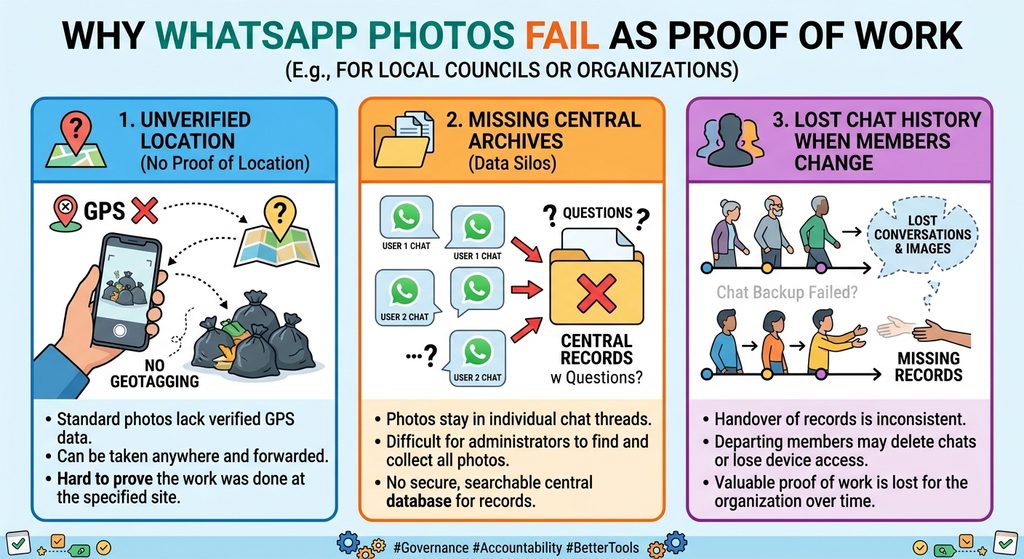
    Why WhatsApp Photos Fail as Proof of Work

    WhatsApp Photos as Proof of Work

    They aren’t GPS verified, so there’s no way to confirm where a photo was taken. They can’t be archived for future reference. And when the MA or council members change, the photos disappear with the old phones and chat groups. A year later, a new council can’t see what was done, when, or by whom. That matters when you’re deciding whether to repair something again or replace it. We wrote more about why vendor proof of work and record keeping keep falling through.

    Why MCST Maintenance Works Get Delayed

    Most MCSTs need a majority vote for amounts above the threshold, so approvals take time. Vendors forget to send the quotation. And when a quotation arrives by email with no reference to the original fault check and initial evaluation, the MA can’t tell what it’s for and has to chase. None of these is anyone being lazy. They’re gaps between people who all have other things to do.

    Shared Responsibility Between MA, Council Members and Vendors

    We don’t think any one party should carry all the record keeping or photo taking. Everyone depends on everyone else, so everyone shares the responsibility. The vendor takes the photos on site, and the MA reviews the work and approves it. The council can then make payment with confidence, because they can see the MA’s approval alongside the proof of work. When the burden is spread out, no single person becomes the bottleneck, and nobody is stuck cleaning up after the others. This is also why council members often take the blame when requests fall through. The required actions are mapped into the work process in the app, so nobody has to remember whose turn it is. See how it works.

    Estate Maintenance Is a Feedback Loop, Not a Linear Process

    MCST management work process loop

    Maintenance also doesn’t end. A lift gets serviced, then it needs servicing again. A defect gets fixed, then something else shows up. A linear process that starts with a fault and stops at payment doesn’t fit that, so we built the work process as a feedback loop. What happens on one job, such as the history, the quotation and the proof of work, feeds into the next one. Over time the estate builds up a record that belongs to the MCST, not to whoever happens to be managing it that year.

    Fix the Process, Not the People

    When a job goes wrong, the usual reaction is to blame the MA, the vendor, or the council. Most of the time the real problem is that nobody set up the steps clearly, and each party assumed someone else would handle it. Fix the process, not the people.

    Ready to try it with your MCST?

    Create a workspace and invite your MA, council members and vendors, or book a demo and we’ll walk you through a real job from fault report to sign-off.

  • “It Can’t Be Done” Usually Means “I’m Still Shopping for a Sharper Knife”

    “It Can’t Be Done” Usually Means “I’m Still Shopping for a Sharper Knife”

    It was a hot afternoon in Singapore, over 33 degrees and no air-con. We were talking about MCST record keeping, and how Basementgrid helps an estate manage its asset records. The vendor manager and vendor technician do the reporting and upload the proof of work themselves in the app, which keeps things simple for the building manager.

    The person across from me said, “That’s impossible. We can’t do that.”

    I hear this a lot, and I think it’s how most people react. If something isn’t done the way it’s always been done, it’s assumed it won’t work. That’s just the social norm.

    Here’s how I think about it. Say someone is looking for a sharper knife because he wants to cut meat and cook a meal for his guests. You tell him he doesn’t need a sharper knife, you can get the meal to his guests without one. He says no. He’s fixed on the knife, and the cooking, and the producing of the meal. The goal was never the knife. The goal was a good meal on the table.

    If he stopped and asked a few more questions, he might realise what he really wants is a home-cooked meal for his guests. Then fine, ordering in won’t work, and that’s a legitimate answer. But if he only holds onto the tool he’s hunting for, he’ll keep saying “it can’t be done.”

    The questions that get you out of this are simple ones. What are you actually trying to end up with? What happens today between the job being done and the record being filed? Who touches it along the way, and does each person add something, or just pass it on? When you answer those honestly, “impossible” often turns into “we’ve just never tried it that way.”

    “But What About Audit?”

    Basementgrid does break a few norms. Vendor managers and technicians take part in your record keeping. Council members can update records and make payments, instead of waiting for an accountant to create them. The best objection I hear is audit. But when you actually walk through it, most of those extra steps aren’t needed. A technician uploading proof of work from the job site is closer to the source than someone retyping it into a spreadsheet a week later. The same goes for having your in-house technician or building manager key the job into a CMMS after receiving the vendor’s report. That’s extra work for sure. It starts out well, then dies off a few months later when people get busy and stop keeping up. The extra process was only ever there because that’s how it was done before.

    Think about what an auditor wants to see. Who did the work, when and where it was done, who approved it, and how it was paid. Those are the things Basementgrid records as they happen: GPS-verified photos from the technician, the council’s approval, and the payment. Nobody has to reconstruct the story at year-end, because the record was made by the people who were there.

    We’ve seen the same reaction to the idea that a small estate can run without a managing agent. I wrote about why a 20-unit condo doesn’t need one, and for many councils the first response is the same: “that can’t work.” The numbers say otherwise.

    Sometimes “It Can’t Be Done” Is Right

    So what are we really solving for? Traditional CMMS software was built for internal teams with a facilities department, trained staff, and someone whose job is to maintain the system. That isn’t an MCST. An MCST is run by volunteer council members, with work done by an uncle-led contractor who runs his business off a phone, and managed by an MA company where most of the staff are retirees. Hand any of them a heavy system and they’ll say it can’t be done, and they’d be right. It can’t be done with that system.

    So the next time someone tells you it’s impossible, ask what they’re trying to achieve before you argue about the tool. Sometimes the answer is that they need a different tool. Often the goal was reachable all along and the norm was in the way.

    Want to see how it works in practice? Book a 15-minute demo or visit the help center.

    Keep reading from the Basement

  • Council Members Get the Blame When Requests Fall Through. Here’s Why It Keeps Happening.

    Council Members Get the Blame When Requests Fall Through. Here’s Why It Keeps Happening.

    Trust, but Verify

    Say you ask a colleague to fix a few errors in a document before it goes to a customer. You trust them. They’re capable, they said they’d do it, and you have your own work to get on with.

    But you still open the file before you hit send. Maybe they fixed three of the four errors. Maybe they fixed it in the wrong version. Maybe they got pulled into something else and never touched it. If the customer finds the mistake, they won’t email your colleague. They’ll email you. Your name is on it, so you’re the one who needs to check.

    Trusting someone to do the work doesn’t mean you skip confirming it’s done.

    Why Council Members Take the Blame

    I’ve spoken to many past MCST council members, and a lot of them say the same thing. They feel unappreciated. When something in the estate isn’t fixed, the tenants and residents come after them. Over time they stop seeing why they’re on the council at all. All they see is the downside, so they quit.

    I think this is very common, and the cause is uncomfortable. A request made by word of mouth usually isn’t followed up. A resident mentions a broken light to a council member, who mentions it to the building manager in passing, who says “will do”. Then everyone gets busy and it’s forgotten. Nobody was lazy on purpose.

    The one who feels it is the person who asked. They don’t know the request got lost. They only know it never got fixed, and they blame the council member.

    So there’s either no system to track requests, or there is one and nobody uses it. Most estates have been told at some point to log everything in the system. Few actually do, because most people don’t like writing things down. That’s just human nature, and no reminder from the council will change it.

    How Basementgrid Differs from Other CMMS Tools

    Most CMMS tools assume the team will log things diligently. They’re built for internal teams with a facilities manager who’s paid to fill in the system. An MCST depends on outside vendors, volunteer council members and a building manager who might be juggling several estates. The system only works if everyone remembers to use it. When it doesn’t, you get what we call ghost maintenance: work gets done, but nobody records it in a way the MCST can trust.

    We took the opposite approach: make the system easier than not using it.

    • Reporting a fault takes a photo and a line of text. Scan the QR code at the location, or let the building manager snap it on site.
    • Every role has one job at each stage, so a work order moves from the building manager to the council, to the vendor, and back to whoever verifies and pays it, without anyone having to chase. If it sits too long, reminders go out automatically. Here’s how the 5 roles work together.
    • Payment is tied to proof. The technician clocks in with GPS and submits photos taken on site (no uploads from the photo library). Work above the council’s approval threshold needs an approver’s sign-off before it goes ahead.
    QR code payment is tagged to approved work order amount and vendor UEN

    Nobody has to believe a status update. The record is there to check. That’s “verify” built into the process, so council members don’t have to chase every request themselves. It’s also what we mean by “Fix the process, not the people.”

    Can Basementgrid Protect Council Members from Legal Liability?

    The other thing I hear is fear. Council members are volunteers, yet they can be accused of breaking the law, or of not acting on something they should have. That’s a lot to carry for an unpaid role.

    I want to be careful here. Basementgrid can’t take away legal responsibility, and we aren’t a law firm. What it does is give you a record. When someone asks “did the council know?” or “what did you do about it?”, you can show:

    • when the issue was reported, and by whom
    • who it was assigned to and when
    • who approved the spend, at what amount, and when
    • what proof of work was submitted
    • that lift servicing, fire safety and warranty deadlines were tracked, with reminders sent before they lapsed

    Without a record, you’re relying on memory and a WhatsApp scroll. With one, you can show that the council acted in good faith and followed a process. The record also stays with the estate when the MA or the council changes, so the next council doesn’t inherit gaps.

    Start with One Work Order

    If you’re a council member thinking of quitting, the problem probably isn’t you. It’s that you’ve been holding the follow-up in your head. You can set up a workspace in about 3 minutes and run a first work order with your existing vendor. Book a 15-minute demo or try it free.

  • The Other 30%: How a Self-Managed MCST Handles Accounts, AGMs and Minutes Without an MA

    The Other 30%: How a Self-Managed MCST Handles Accounts, AGMs and Minutes Without an MA

    In our last post we went through the 70% of a managing agent’s job, which is maintenance coordination, and why a system can do most of it. The other 30% is admin: the books, the AGM, and the council meeting minutes. This is the part people assume they need an MA for, so let’s go through it.

    Good news: none of it needs a full-time person. All three can be outsourced or largely automated, and the costs are lower than most councils expect.

    1. Accounting: hand it to a firm that does this all day

    This is the easiest one. Plenty of accounting firms in Singapore already specialise in MCST bookkeeping, for example WLP and STAC. You send them the paperwork, they keep the books and prepare the financial statements.

    It’s also what smaller MA companies do. A small MA doesn’t have enough clients to justify a full-time accounting staff member, so they outsource it too. The logic is simple. An accounting firm with dozens of MCSTs as clients can charge each one less, because the work is repeatable and they spread their overhead across all of them. A single condo, or a single small MA, can’t get that economy of scale on its own. So when you outsource directly, you get the same deal the MA would have gotten, minus the MA’s markup.

    As a rough guide, budget about $600 a month for the bookkeeping, plus about $1,000 a year for compiling the financial statements.

    The accounts also need to be audited every year, so include that in the budget too. For a 128-unit estate, the audit costs about $1,000 a year.

    2. MCST AGM: outsource the hosting, and budget for the paperwork around it

    An AGM has a lot of moving parts. Someone has to prepare the agenda and resolutions, host and chair the meeting, and write the minutes afterwards. Most volunteer councils don’t want to do all of that, and a chair who isn’t experienced can make a long meeting even longer.

    You can outsource it. For example, A4 International offers a service to conduct and chair the AGM or EOGM at around $1,000 per year.

    Read the fine print, though. That fee doesn’t cover preparing the AGM documents, distributing the AGM booklet, technical support, or the presentation slides. Set aside another $500 to $800 for those. So a realistic AGM budget is about $1,500 to $1,800 a year, and that’s for a fully outsourced meeting.

    3. Council meeting minutes: record, transcribe, let AI draft, secretary confirms

    This is the one that’s changed the most recently. Here’s the workflow:

    1. Record the council meeting and run it through a transcription tool such as myminutes.ai.
    2. Feed the transcript into an AI tool like Claude and ask it to turn the transcript into a formal set of minutes.
    3. The council secretary reads it, corrects anything that’s wrong, and confirms it before it gets sent out.

    Step 3 matters. The AI drafts, but a person still signs off on what goes on record. That’s the same check you’d want on minutes written by hand.

    What used to take an MA staff member hours of note-taking and formatting now takes a fraction of the time. The output is also arguably more consistent, because the format doesn’t change depending on who was taking notes that month.

    What it adds up to

    Here’s what the admin side costs per year when you outsource it, using the figures above:

    ItemCost per year
    Bookkeeping ($600 x 12 months)$7,200
    Financial compilation$1,000
    Audit (128-unit estate)$1,000
    AGM chairing and hosting$1,000
    AGM documents, booklet distribution and slides$500 to $800
    Total$10,700 to $11,000

    Council meeting minutes aren’t in the table because the cost is small. A transcription tool and an AI subscription cost far less than what an MA charges for the same job, and the secretary’s review time is free.

    Compare that total with what you’re paying an MA today. If the MA’s management fee covers more than this list plus the maintenance side, you have a clear number to bring to your next council meeting.

    Putting it together

    Between the 70% from the last post and the 30% here, there isn’t a piece of a managing agent’s job that a self-managed council can’t cover. Maintenance runs on a system, accounting and AGMs go to specialists you pay directly, and minutes take minutes instead of hours.

    Will it be the right call for every estate? No. Some councils really don’t have anyone with the time, and that’s what the MA option is for. But the choice should come from what your council needs, not from a belief that the law or the workload forces you to hire one.

    If you want to see how the maintenance side works, book a demo or get started here.