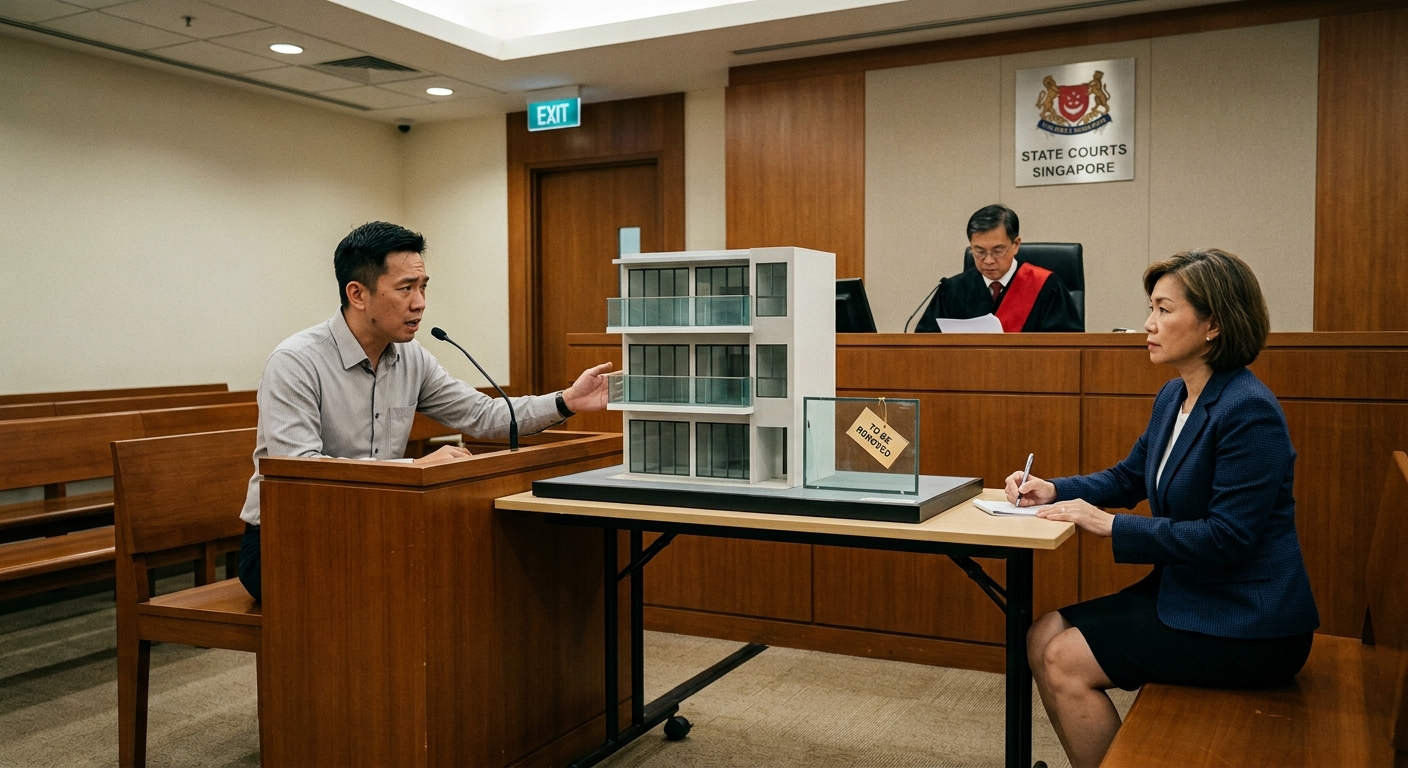
Five years. Two court orders. $17,000 in costs. All over one glass curtain on a balcony.
That’s the shape of a recent case involving Sea Esta, a condo on Pasir Ris Link, where the management corporation spent years trying to get a homeowner to remove a balcony installation that was never approved. If you haven’t read the full writeup on Stacked Homes, the short version is this: an owner installed a glass curtain without sign-off, a tribunal ordered it removed and gave the owner a path to reapply, the owner missed the deadline and kept submitting incomplete applications, the MCST kept rejecting them, and the whole thing eventually needed a District Court judgment and a fresh injunction before the removal could actually happen.
We read this one closely, because it’s exactly the kind of situation Basementgrid was built around. Not because the MCST did anything wrong. They didn’t. The court agreed the curtain was unauthorised from day one, and the MCST had the law on its side the entire way through. What the case actually shows is something quieter and more common: even when an MCST is completely in the right, a renovation approval that isn’t tracked as a live, owned process can drift for years before anyone is forced to act on it.
The approval process existed. Nobody was tracking it.
Here’s the part that’s easy to miss in a case built around legal provisions and court orders. The 2021 tribunal ruling didn’t just tell the owners to remove the curtain. It gave them a process: submit a renovation application within two weeks, and the MCST would respond within two weeks after that.
That’s a form-and-approval workflow. Most estates have some version of it, whether it’s a PDF the owner emails in, a physical form dropped off at the management office, or a request buried in a WhatsApp thread. The problem in this case wasn’t that the process didn’t exist. It’s that once the application was late, incomplete, and rejected, there was no system forcing anyone to close the loop. The owners kept submitting partial applications. The MCST kept rejecting them for the same reasons. Months passed, then years, and by the time the matter got to court, both sides were arguing over what had or hadn’t been submitted, and when.
None of that ambiguity should have been possible. A renovation request that’s approved, rejected, or sitting incomplete is exactly the kind of thing that should be visible at a glance, with a clear record of who submitted what, what was missing, and how long it’s been sitting there. Instead, it took a letter from lawyers, dated months after the original deadline, to spell out in writing what had actually been missing from the applications all along.
Approval without follow-through isn’t approval
The other detail worth sitting with: even after the District Court enforced the removal in 2023, nothing happened. The MCST sent reminder after reminder. No further applications came in. It wasn’t until the MCST tried to send its own people in to do the work directly, over a year later, that things escalated to an injunction.
A court order is not a work order. Somewhere between “the owner must comply” and “the glass curtain is actually gone,” someone has to be responsible for following up, someone has to be assigned to inspect or execute the fix, and someone has to formally close it out. When that ownership isn’t built into the process, “the MCST is handling it” can quietly mean nobody specific is.
This is the gap Basementgrid closes
This is the exact reason we built Basementgrid around a form-to-work-order flow rather than just a form.
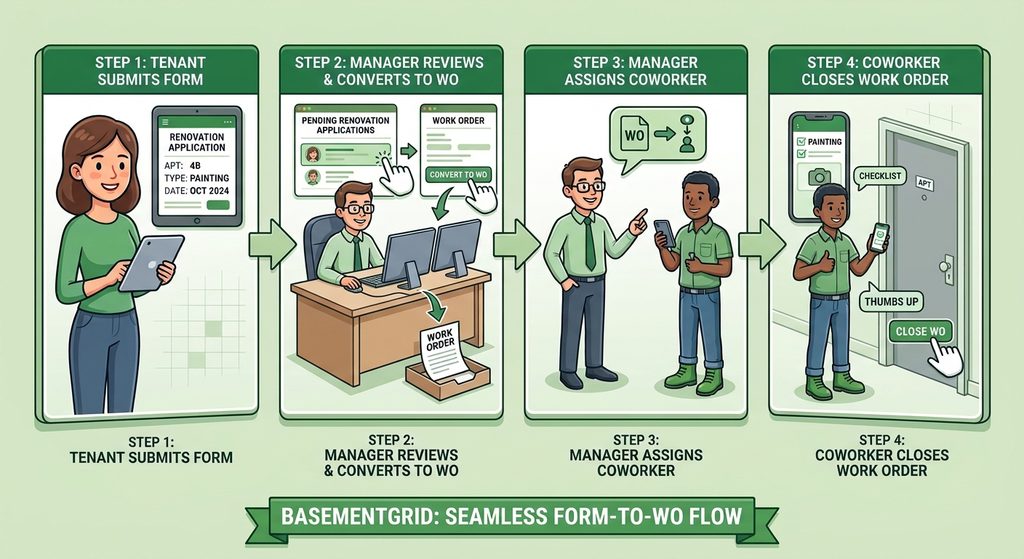
The way it works: an owner planning a renovation fills out a digital renovation application, similar in spirit to what you’d fill out on a community app like iCondo, but the difference is what happens after it’s submitted. The building manager reviews it and, if it’s approved, converts it directly into a work order inside the same system. That work order gets assigned to a specific person, whether that’s the BM themselves, a coworker, or a security guard doing a site check, and it stays open, visible, and attributed to that person until it’s marked complete.
Nothing sits in limbo. If an application is incomplete, that’s logged against the submission, not lost in an email thread six months later. If a renovation needs a follow-up inspection, that’s a work order with an owner and a due date, not a mental note. And when the job is actually done, whoever was assigned has to close it out, which means there’s a timestamped record of who signed off and when, not just a form that was “approved” with no trace of what happened next.
Sea Esta’s MCST didn’t lose because their process was wrong. They lost years because their process had no built-in accountability once things went off track. A council changes every year or two. A managing agent can be swapped out entirely. If the record of who approved what, who was supposed to follow up, and who actually closed it lives in someone’s inbox, that history walks out the door with them.
This is really what we mean when we say “fix the process, not the people.” The Taylors weren’t going to comply just because the MCST asked nicely, and no amount of reminder emails changed that. What actually needed fixing wasn’t anyone’s attitude. It was the absence of a system that made the next step, and who owned it, obvious from the start.
Basementgrid is built for MCSTs, building managers, and MAs who want renovation approvals, defect tracking, and vendor work orders on one system, with a full audit trail that survives council and MA turnover. See how it works →