Category: MCST Governance

  • The 70% Problem: Why Most Condos Think They Need a Managing Agent (They Don’t)

    The 70% Problem: Why Most Condos Think They Need a Managing Agent (They Don’t)

    BCA is pretty clear about this on their own site: a Managing Agent “may be employed” by an MCST — it’s optional, not a requirement under the Building Maintenance and Strata Management Act. The council is empowered, and expected, to manage its own affairs. What trips most councils up isn’t the law. It’s that maintaining shared property — lifts, pools, water tanks, cleaning, security, landscaping — genuinely takes a system to run well, and most self-managed estates never build one.

    We broke this down before: an MA’s job is roughly 70% maintenance coordination and 30% admin work (books, minutes, AGMs). We briefly covered how to handle the 30% with outsourced bookkeeping and AI-assisted minutes. This article is about the 70% — the shared-facility maintenance most councils assume needs an MA’s staff to chase. It doesn’t. It needs a system.

    And it’s worth being precise about what “system” means here. Basementgrid isn’t a checklist you hand your building manager and hope he ticks off. A checklist still depends on someone remembering to open it, fill it in honestly, and flag it if something’s wrong. The maintenance process — schedules, thresholds, sign-offs, proof of work — is built into the platform itself. It’s not a document your BM checks. It’s the thing that checks on your building for you. That’s the difference between hoping your BM caught something and actually having eyes on every lift, pool, and vendor whether or not anyone remembered to look.

    1. Lifts: The One Thing You Can’t Afford to Get Wrong
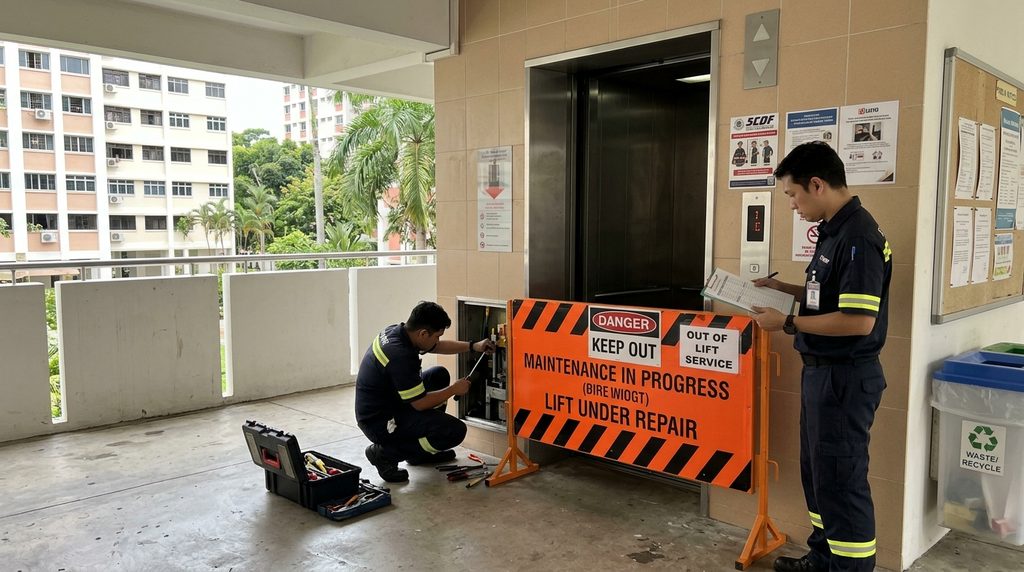
    Monthly Lift Maintenance

    Lifts are the one area where the compliance stakes are highest and the least optional. BCA requires all lifts to be maintained by a BCA-registered Fixed Installation contractor, at a minimum monthly if no manufacturer schedule applies, plus an annual inspection and test by that contractor with an independent examiner present. Get this wrong and it’s not just a fine — it’s a safety issue and it affects your Permit to Operate (PTO).

    On Basementgrid, every lift is set up as an asset with its own digital record: commissioning date, warranty status, and a full history of every work order raised against it. When the monthly service or annual test comes due, the reminder goes to whoever’s tracking compliance instead of living in someone’s head or a shared spreadsheet. And because every WO ties an amount to a specific piece of work, the council can see that the invoice paid to the lift contractor actually matches what was issued and done — not just “lift maintenance, $X” on a bank statement with no paper trail behind it.

    2. Cleaning Contractors: Paying for a Checklist, Not a Promise

    Cleaning contracts usually promise a scope — daily lobby cleaning, weekly common corridor mopping, quarterly deep clean — that nobody actually checks against. Basementgrid lets you build a custom checklist matched to what’s in the contract, whether it runs monthly or quarterly, so the contractor has a defined list to complete rather than a vague expectation, and the council has something concrete to hold them to.

    Once the cleaners mark the checklist complete, it goes to the BM for review before anything gets billed. If the BM isn’t satisfied, they can reject it and send it back for rework — no invoice goes out until the BM actually accepts the work. Only once it’s accepted can the cleaning vendor submit their invoice. Every step, checklist completion, rejection, rework, acceptance, is timestamped, so there’s no after-the-fact argument over whether the work was done properly or on time.

    3. Security: From Watchman to Watch System

    Security: From Watchman to Watch System

    If your estate has a stationed guard, patrols usually turn up faults that never get logged anywhere formal — a broken gate sensor, a flickering corridor light, a leaking pipe in the basement. On Basementgrid, the guard can report a fault directly during patrol, and it converts straight into a work order that goes to the right vendor. The guard can hold the role of raising the WO itself, so a fault gets logged the moment it’s spotted rather than waiting for the BM to be free to do it. Acceptance of the completed work still stays with the BM, so the guard’s job is just to flag it fast, not to sign off on it. That split keeps the BM’s workload lighter without losing the checkpoint that matters. For anything above a set spending threshold, it doesn’t go out automatically — it needs a majority vote from council members first, using the same approval threshold that already governs other spending on the platform. Small stuff gets fixed fast; anything material still needs the council’s sign-off.

    Worth noting too: CCTV is increasingly the new guard. The Singapore Police Force itself has been moving in this direction in our own neighbourhoods, expanding its PolCam network to more than 200,000 cameras with officers running “virtual patrols” from a command centre rather than relying solely on boots on the ground. If your estate is weighing whether it still needs a stationed watchman or concierge, that’s the direction worth considering — CCTV coverage feeding into a system like Basementgrid, rather than a person whose only record of a patrol is their word for it.

    The one gap CCTV alone doesn’t close is telling a false alarm from a real one before it escalates. For that, the best bet is still a resident volunteer in the community, someone who can eyeball the footage or the site itself and confirm whether it’s worth acting on, rather than every alert automatically triggering a callout.

    4. Water Tank Washing: The Annual Deadline Nobody Remembers Until It’s Late

    Annual water tank washing

    This one has real teeth. PUB requires every MCST with a water storage tank to engage a Licensed Plumber to inspect, and where needed clean, disinfect and certify the tank at least once every 12 months. Miss the deadline and it’s an offence under the Public Utilities (Water Supply) Regulations — a fine of up to $10,000, or up to 12 months’ imprisonment, or both. PUB sends reminder emails, but they explicitly tell MCSTs not to rely on that alone.

    Basementgrid tracks each tank’s certification date and reminds council members well ahead of renewal, not the week it’s due, so there’s enough runway to engage a Licensed Plumber and get it done instead of scrambling against the deadline.

    5. Swimming Pool: One Missed Test Away from a Compliance Headache

    NEA licenses swimming pools as Aquatic Facilities, and licensees have to send water samples to an SAC-accredited lab and submit results to NEA on a regular cycle — monthly submissions are the norm, alongside daily on-site testing for things like pH and chlorine. It’s easy for this to quietly lapse when it’s sitting on a pool contractor’s checklist and nobody’s cross-checking it. Basementgrid tracks the pool contractor’s testing and submission cadence against what NEA expects, so the council can catch a missed cycle before it becomes a compliance problem instead of finding out after the fact.

    6. Landscaping, Pest Control, Electrical: Proof They Actually Showed Up

    These are lower-stakes but higher-frequency — monthly visits that either happen properly or quietly don’t. Every vendor clock-in on Basementgrid is GPS-verified against the property, so there’s a real record that the landscaper, pest control technician, or electrician actually showed up rather than just submitting an invoice. Anything they flag as needing repair goes through the same work order flow as everything else — one process, not a different tracking method for every vendor type.

    7. Other Vendors: Never Start From Zero Again

    Need a new contractor for something that doesn’t fit an existing category? Every vendor that’s registered on Basementgrid, across any estate, can be searched and asked for a quote directly through the platform instead of starting from a WhatsApp recommendation and hoping. We’ve written more about how the vendor side of Basementgrid works if you want the full picture.

    No Ghost Maintenance: Every Job, Traceable End to End

    Tie all seven together and the pattern is the same process, repeated: a designated council member acting as building manager creates the work order, assigns it, and verifies the work with proof uploaded by the vendor — all from a phone, no separate system per vendor type, and no reliance on anyone remembering to check a list. Once a WO is issued, its details are locked — scope, amount, vendor, can’t be quietly edited after the fact by either side, so there’s no room for a dispute over what was actually agreed.
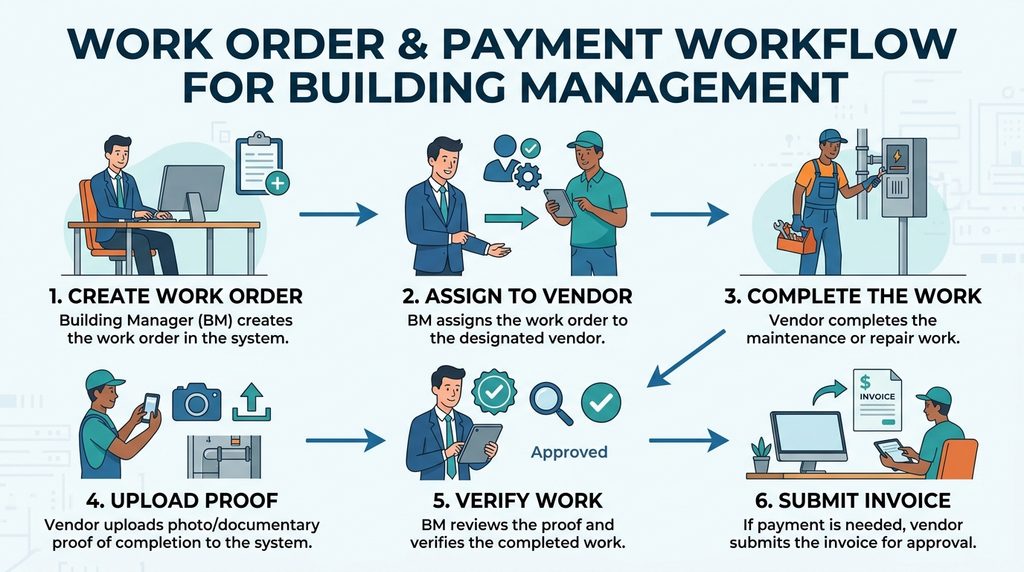
    Basementgrid Work Order Workflow

    And it closes the loop all the way to payment. Residents can submit a work request in the app; the BM approves it and issues it to a vendor. Once the vendor finishes and uploads proof, the BM verifies it, and the invoice generates a PayNow QR matched exactly to the work order amount and the vendor’s UEN. Council members scan and pay — no manual reconciliation, no guessing whether an invoice matches what was actually approved. If something stalls, the activity log shows exactly where, so nobody’s left wondering if it’s the BM, the vendor, or the council holding things up.

    Still need someone to actually be the BM? That’s fair — not every council has a volunteer with the time. Book a demo with us and we’ll put you in touch with a Managing Agent who already runs on Basementgrid, so you get the system without needing to find the person yourself.

    Prefer to set it up yourself first? Get started here.


    Next up: the other 30% — bookkeeping, AGMs, minutes, and compliance paperwork — and how a self-managed council handles that without an MA either.


  • Why a 20-Unit Condo Doesn’t Need a Managing Agent

    Why a 20-Unit Condo Doesn’t Need a Managing Agent

    If you’re on the council of a small estate, you’ve probably had this thought at least once: “What exactly are we paying our MA $1,000+ a month for?”

    For a 200-unit condo with a swimming pool, gym, function room and a full-time on-site staff, the answer is obvious. For a 20-unit walk-up or boutique development, it’s a lot less clear. Let’s break down what an MA actually does, and whether a small estate really needs to pay for all of it.

    What Does a Managing Agent Actually Do?

    Strip away the sales pitch and an MA’s job splits roughly into two buckets:

    • 70% maintenance coordination — logging faults, chasing vendors, tracking preventive maintenance, following up on compliance deadlines.
    • 30% admin work — taking minutes, chairing or coordinating AGMs, keeping the books, and filing annual compliance paperwork.

    Neither of these requires an MA specifically. They require a system. Here’s how a 20-unit MCST can cover both without one.

    Running a Self-Managed MCST: The 30% Admin Work

    Outsourced Bookkeeping for a Small MCST

    This is the easiest one to outsource. A 20-unit estate doesn’t generate many transactions a month, so you don’t need a dedicated accountant, let alone an MA’s back office. Services like Osome will handle monthly bookkeeping and year-end financial statements for as little as $200 a month, scaled to your transaction volume. That’s a fraction of what you’re paying an MA to do the same thing, often less efficiently.

    AI-Generated Minutes for MCST Meetings

    Record the meeting with a transcription tool like myminutes.ai, then feed the transcript into an AI tool like Claude to turn it into a formal set of minutes. What used to take an MA staff member hours of manual note-taking and formatting now takes a fraction of the time, and the output is arguably more consistent.

    Running an AGM Without a Managing Agent

    A 20-unit AGM doesn’t need the formality of a 200-unit one. It can run as a round-table meeting chaired by the council Chairman. Use an AI tool to draft the agenda and resolutions in advance, and record and transcribe the meeting the same way as above. Disagreements can be worked out in the room rather than managed through a rigid, MA-scripted process.

    That said, don’t skip the guardrails entirely. For a start, it’s worth engaging a professional on a one-off basis to check that your AGM process and resolutions are legally sound — the same way you’d bring in a lawyer to catch legal blind spots rather than run every decision through one.

    Automating the 70%: Maintenance Coordination for a Small MCST

    This is the bulk of the job, and it’s also the part software is best suited to replace. This is where Basementgrid comes in. Worth a quick clarification here: Basementgrid isn’t a community app like iCondo, and it isn’t trying to be one — it’s built specifically for the maintenance and vendor side of running an estate, not for residents to book facilities or read announcements.

    Basementgrid automates the full maintenance lifecycle: tracking preventive maintenance schedules, logging faults as they’re reported, converting them into work orders, and following up on compliance reminders so nothing falls through the cracks.

    Vendor Payments and PayNow QR for MCST

    Vendor Payment on Basementgrid App

    Payments are handled too. Vendors submit invoices directly on the platform, and each approved invoice auto-generates a PayNow QR code with the correct amount and the vendor’s UEN already attached. One signatory — usually the treasurer or secretary — can double up as maker and approver, creating the payment in their bank app and approving it, while another signatory acts as the second approver. This satisfies most MCSTs’ requirement for double approval on bank transactions, without needing extra headcount. A monthly transaction report is generated automatically for audit purposes.

    The Building Manager Role Without a Managing Agent

    On the ground, the council member acting as “building manager” only has three things to do on Basementgrid: convert a work request into a work order, assign it to a vendor, and review the completed work. Vendors are required to submit GPS-verified job completion photos, so there’s proof of work on file without anyone having to chase it down.

    Finding someone for this role isn’t as hard as it sounds. Many estates have retirees on the council with time on their hands and a genuine stake in how well the place is run. Compare that to an MA staff member managing a portfolio of a dozen estates, who mostly shows up when something’s already gone wrong. Who’s going to put more care into the job: someone who lives there and treats it like their own building, or someone juggling it as one account among many?

    Is a Managing Agent Worth It for a Small MCST?

    If your estate is paying an MA $1,000 or more a month, add up what you’d spend replacing them piece by piece: outsourced bookkeeping, an AI transcription and minutes workflow, an occasional legal check-in, and Basementgrid for maintenance and payments. For most 20-unit estates, that adds up to meaningfully less than an MA retainer, and it’s hard to argue the level of service goes down.

    What would you rather spend the difference on? A monthly gathering for the whole estate probably does more for a 20-unit community than another line item in an MA contract.

    If that math makes sense to you, get started with Basementgrid and see what running your own maintenance actually looks like.

  • A Glass Curtain, Two Court Orders, and Five Years: What MCSTs Should Actually Learn From Sea Esta

    A Glass Curtain, Two Court Orders, and Five Years: What MCSTs Should Actually Learn From Sea Esta

    Five years. Two court orders. $17,000 in costs. All over one glass curtain on a balcony.

    That’s the shape of a recent case involving Sea Esta, a condo on Pasir Ris Link, where the management corporation spent years trying to get a homeowner to remove a balcony installation that was never approved. If you haven’t read the full writeup on Stacked Homes, the short version is this: an owner installed a glass curtain without sign-off, a tribunal ordered it removed and gave the owner a path to reapply, the owner missed the deadline and kept submitting incomplete applications, the MCST kept rejecting them, and the whole thing eventually needed a District Court judgment and a fresh injunction before the removal could actually happen.

    We read this one closely, because it’s exactly the kind of situation Basementgrid was built around. Not because the MCST did anything wrong. They didn’t. The court agreed the curtain was unauthorised from day one, and the MCST had the law on its side the entire way through. What the case actually shows is something quieter and more common: even when an MCST is completely in the right, a renovation approval that isn’t tracked as a live, owned process can drift for years before anyone is forced to act on it.

    The approval process existed. Nobody was tracking it.

    Here’s the part that’s easy to miss in a case built around legal provisions and court orders. The 2021 tribunal ruling didn’t just tell the owners to remove the curtain. It gave them a process: submit a renovation application within two weeks, and the MCST would respond within two weeks after that.

    That’s a form-and-approval workflow. Most estates have some version of it, whether it’s a PDF the owner emails in, a physical form dropped off at the management office, or a request buried in a WhatsApp thread. The problem in this case wasn’t that the process didn’t exist. It’s that once the application was late, incomplete, and rejected, there was no system forcing anyone to close the loop. The owners kept submitting partial applications. The MCST kept rejecting them for the same reasons. Months passed, then years, and by the time the matter got to court, both sides were arguing over what had or hadn’t been submitted, and when.

    None of that ambiguity should have been possible. A renovation request that’s approved, rejected, or sitting incomplete is exactly the kind of thing that should be visible at a glance, with a clear record of who submitted what, what was missing, and how long it’s been sitting there. Instead, it took a letter from lawyers, dated months after the original deadline, to spell out in writing what had actually been missing from the applications all along.

    Approval without follow-through isn’t approval

    The other detail worth sitting with: even after the District Court enforced the removal in 2023, nothing happened. The MCST sent reminder after reminder. No further applications came in. It wasn’t until the MCST tried to send its own people in to do the work directly, over a year later, that things escalated to an injunction.

    A court order is not a work order. Somewhere between “the owner must comply” and “the glass curtain is actually gone,” someone has to be responsible for following up, someone has to be assigned to inspect or execute the fix, and someone has to formally close it out. When that ownership isn’t built into the process, “the MCST is handling it” can quietly mean nobody specific is.

    This is the gap Basementgrid closes

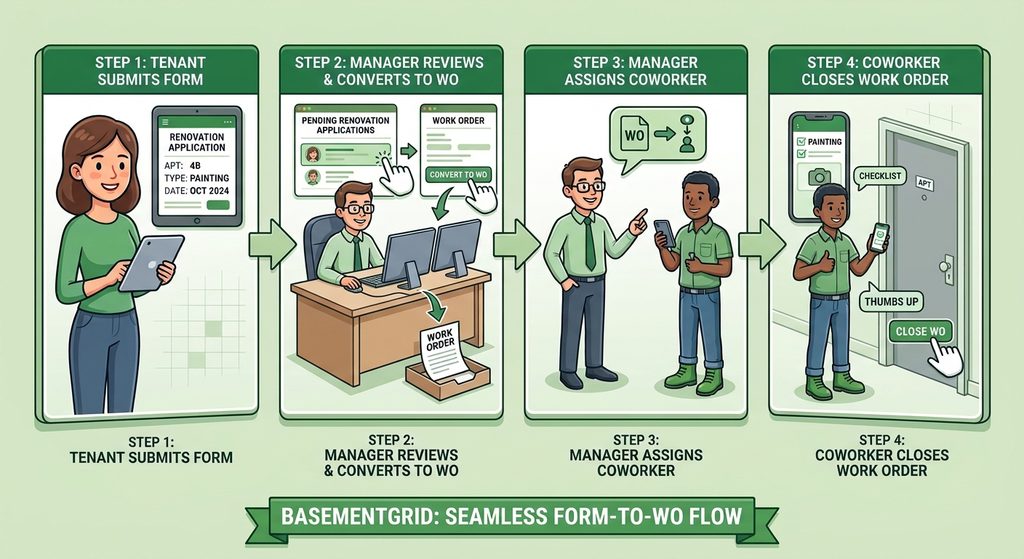
    This is the exact reason we built Basementgrid around a form-to-work-order flow rather than just a form.

    Renovation Approval Flow on Basementgrid

    The way it works: an owner planning a renovation fills out a digital renovation application, similar in spirit to what you’d fill out on a community app like iCondo, but the difference is what happens after it’s submitted. The building manager reviews it and, if it’s approved, converts it directly into a work order inside the same system. That work order gets assigned to a specific person, whether that’s the BM themselves, a coworker, or a security guard doing a site check, and it stays open, visible, and attributed to that person until it’s marked complete.

    Nothing sits in limbo. If an application is incomplete, that’s logged against the submission, not lost in an email thread six months later. If a renovation needs a follow-up inspection, that’s a work order with an owner and a due date, not a mental note. And when the job is actually done, whoever was assigned has to close it out, which means there’s a timestamped record of who signed off and when, not just a form that was “approved” with no trace of what happened next.

    Sea Esta’s MCST didn’t lose because their process was wrong. They lost years because their process had no built-in accountability once things went off track. A council changes every year or two. A managing agent can be swapped out entirely. If the record of who approved what, who was supposed to follow up, and who actually closed it lives in someone’s inbox, that history walks out the door with them.

    This is really what we mean when we say “fix the process, not the people.” The Taylors weren’t going to comply just because the MCST asked nicely, and no amount of reminder emails changed that. What actually needed fixing wasn’t anyone’s attitude. It was the absence of a system that made the next step, and who owned it, obvious from the start.


    Basementgrid is built for MCSTs, building managers, and MAs who want renovation approvals, defect tracking, and vendor work orders on one system, with a full audit trail that survives council and MA turnover. See how it works →

  • The MA Changes. The App Doesn’t.

    The MA Changes. The App Doesn’t.

    Every MCST in Singapore has been through this at some point. The council isn’t happy with the current Managing Agent, so they switch. New MA comes in, new team, new habits — and somewhere in that handover, three years of work order history, defect records, and “who approved what” disappears into someone’s old email inbox.

    Then six months later, the same complaints resurface. Not because the new MA is worse. Because nothing was ever actually systemized in the first place.

    Why Strata Management Software Beats WhatsApp, Email, and iCondo for MA Handovers

    Singapore strata management already has no shortage of tools. WhatsApp for the quick stuff. Email for the “official” stuff. iCondo or a booking portal for facility bookings and announcements. Google Drive for whatever documents someone remembered to upload.

    The problem isn’t a lack of tools. It’s that none of them are built around the actual work. WhatsApp doesn’t know what “approved” means. Email doesn’t track whether a vendor showed up. A booking app has nothing to do with a leaking pipe on Level 12.

    Basementgrid isn’t trying to be a nicer version of any of those. It’s built around one idea: whichever MA is managing the estate, the process stays the same, because the process is baked into the app — not into any one person’s head.

    That’s the difference between a communication tool and an operating system. You can switch MAs. You can’t switch out of the workflow.

    Work Order Tracking Software Solves the “He Said, She Said” Problem in Estate Management

    Ask any council member what actually eats their time and goodwill, and it’s rarely the big-ticket items. It’s the small, recurring disputes:

    • “We approved that repair weeks ago, why hasn’t it started?”
    • “The MA says the vendor was informed. The vendor says they never got the job.”
    • “Who signed off on this quotation, and at what amount?”

    None of these are hard problems technically. They’re hard because the “record” of what happened lives in scattered chat threads, forwarded emails, and people’s memories — all of which are selectively remembered, conveniently misplaced, or simply gone when the MA changes.

    Basementgrid treats every work order as a running checklist with a status, an owner, and a timestamp. Raised, authorized, in progress, completed, paid — each step is logged against a person and a time, not a recollection. When something stalls, you don’t need to ask around. You look at the record and you can see exactly where the delay sits, and whose desk it’s sitting on.

    That’s not about assigning blame. It’s about removing the ambiguity that makes blame the default conversation in the first place.

    Trust But Verify: Council Approval Workflow Software for MCST Funds and Vendor Accountability

    Here’s the uncomfortable truth about strata management: it isn’t a mom-and-pop shop where one person makes every call and wears every consequence. It’s a business relationship involving the MCST’s funds, multiple vendors, a rotating council of volunteers, and an MA that may or may not be the same one in five years.

    In that setup, “we trust our MA” and “we have a system that verifies what our MA does” are not in conflict — they’re the same thing, done properly. A good MA benefits from a system that clearly shows their work is on track. A council benefits from not having to take anyone’s word for it. And when an MA transition happens, the estate’s operational history doesn’t leave the building with them.

    That’s the responsibility ambiguity we built Basementgrid to close. Not by adding more oversight meetings or more WhatsApp groups, but by making the approval trail, the status of every job, and the accountability for every stage something anyone with access can check — anytime, without having to ask. It’s worth remembering that under the BMSMA framework, the council remains legally responsible for the estate even when it delegates day-to-day duties to an MA — which is exactly why the paper trail can’t be allowed to depend on whichever MA happens to be holding it at the time.

    Fix the process, not the people.