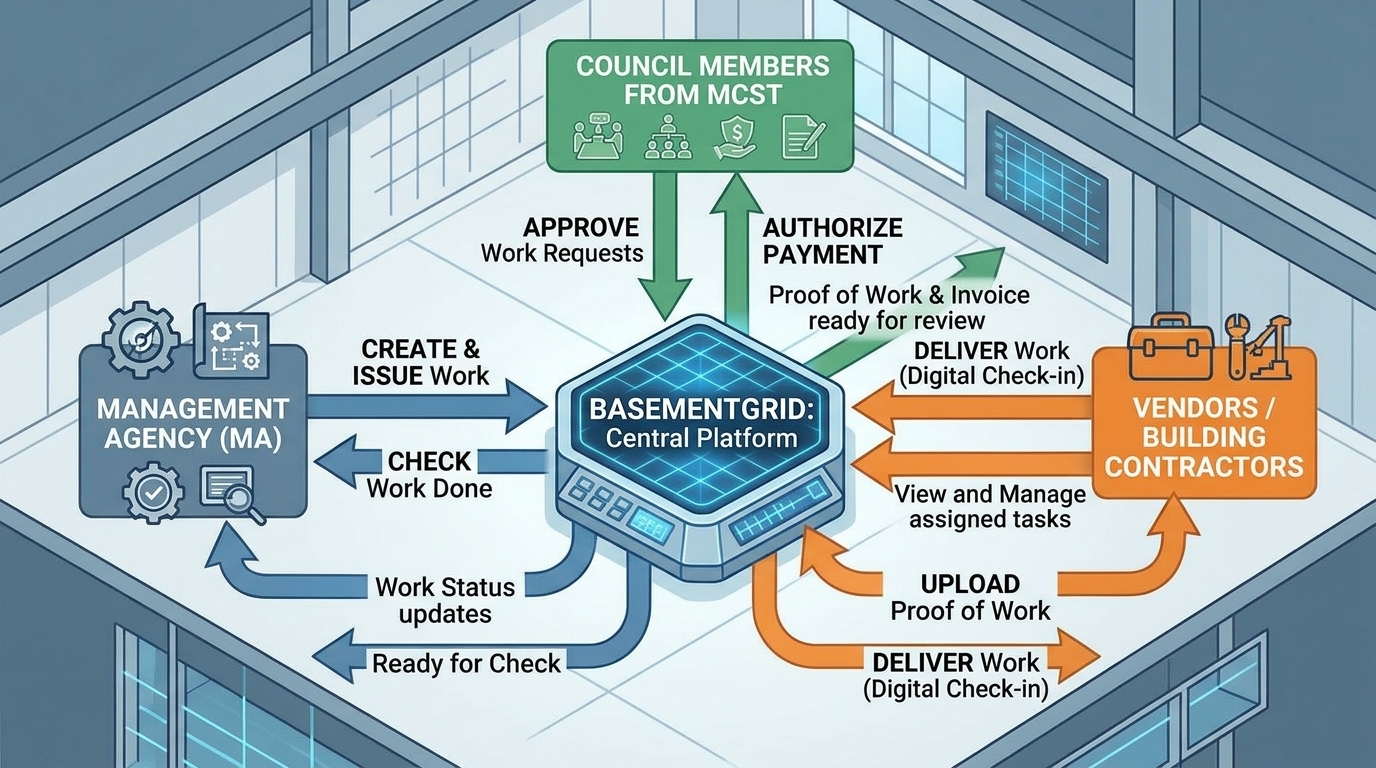
In the last post I wrote about why estate management collaboration is a three-party problem: the MA, the council, and the vendors. Each party has its own organisation, its own priorities, and its own way of working.
You could build a work order tool and make the BM’s life easier. You could build an invoice tool and make the vendor’s life easier. Each would work for the one party it was built for, but the problems from that post would still be there, because they sit between the parties, not inside any one of them.
So we borrowed a playbook from how platforms work, and this is how we build Basementgrid.
Start From the Destination, Not the Feature List
We look at the final destination first, which is a job done properly and paid for. Then we choose the route and pick the actors involved. For each actor, we decide the minimum action they need to take at each stop. Then we plan the route with the fewest stops, and the required actions at each one.
This isn’t about disturbing the usual process. The traditional flow was drawn up before PCs and mobile phones existed, and a lot of its steps are there because people have always done them that way. Some of those steps are work a phone can do for us now. Cutting stops means less disruption on the way to where everyone already wants to go.
Three things shape how we decide who does what.
1. Collaboration Starts by Cutting What Council Members and MAs Have to Do
The honest truth is that many council and MA members are older, and attention and patience for software tends to be lower than for middle-aged users. They are also the minority on the council and MA side, so it’s almost impossible to ask them to learn a CMMS.
So we cut what they have to do. Most processes have an AI suggestion and a one-tap action, and we shift the remaining work to the other parties, mainly the vendor manager and technician. The rule is less typing, more tapping. The AI does most of the data entry, and you do the checking.
2. A Work Order Approval Process That Decides Once, Not Twice
Take a common setup. The rules say a BM can issue a work order up to a certain amount, but a council member must approve the payment once the invoice comes in.
If you’ve already set that rule, why approve the same job twice? On Basementgrid, setting the rule is the approval. The council authorises the payment up front, under the conditions they chose. A work order then works a bit like a smart contract. Once the BM has verified the work is done and the vendor has submitted the invoice, those conditions are met and the payment is already authorised. The approver just pays it in the bank app.
This doesn’t take away the council’s say. If something looks dubious, the council can log their questions in the work order, or stop it before the BM verifies and accepts the work. What we remove is the second approval after everything has already checked out.
I know some people won’t like this. “Your convenience isn’t everyone’s convenience” is something we say a lot. A process that works for all three parties will always ask someone to give up a habit. Uber didn’t ask taxi companies how they’d like to be disrupted, and we’re taking the same attitude to estate management.
3. How to Get Vendors, Councils and Building Managers Working Together Without Training
Every stakeholder belongs to a different organisation. Training doesn’t work, because nobody has an incentive to change how they do things unless they gain something from it. So each step in Basementgrid is pushed along by either a direct incentive or a guardrail.
- Vendors: This is the simplest. If you want to get paid, follow the system. Show proof of work, submit your invoice, and get paid.
- Council members: If there’s a red flag, you get notified. You approve works and pay without having to rely on someone else’s opinion.
- Building managers: You save the paperwork and the time spent on documentation. It’s all in the app, and you only accept the work order once what you required has been submitted.
Each party gets something in return for doing its part, and the system doesn’t move forward until the part is done.
Where this leaves us
None of this is a new idea in other industries. Platforms have worked this way for years. Estate management just hasn’t had one yet, and we’re building it.
Fix the process, not the people.
Leave a Reply