Author: Fred C.

  • MCST Building Management: How Data Kidnapping Holds Your Estate Hostage

    MCST Building Management: How Data Kidnapping Holds Your Estate Hostage

    Every year, condos and industrial estates across Singapore pay millions in “ransom money” to incompetent vendors and subpar Managing Agents (MAs). They don’t call it ransom, of course. They call it “the trouble of switching.”

    Let’s call it what it is: data kidnapping, and it’s quietly plaguing property maintenance across every MCST in Singapore.

    When your vendor holds the only copy of your equipment history, they own you. When your MA’s diligence is the only thing keeping your compliance records from vanishing, they own you too.

    Councils tolerate nonsense. They overlook phantom billing. They compromise on terrible service. Why? Because the alternative feels worse: a black hole of missing data the moment you fire them.

    The MCST Building Management Handover Mess (And the Illusion of Control)

    Singapore’s property management industry has quietly accepted chaos as the status quo.

    • When a Managing Agent changes, the handover is a nightmare. Months later, the new team is still chasing the old team for repair logs that “went missing” during the transition.
    • When an onsite building manager resigns, decades of institutional knowledge walk out the door with them.

    MCST councils and MAs live in fear of this operational amnesia. So they stick with the devil they know, because losing the data feels riskier than keeping a bad vendor around.

    That’s the trap. And it’s exactly why so many estates stay stuck with underperforming MAs and vendors for far longer than they should.

    What Data Kidnapping Actually Costs Your MCST

    The costs rarely show up as a single line item, which is part of why councils underestimate them.

    Take a lift maintenance contract. If the outgoing vendor’s service history lives only in their own filing cabinet, the incoming vendor has no baseline to work from. They can’t tell you when a part was last replaced or whether a fault is recurring. So they start fresh, sometimes literally re-inspecting equipment that was serviced weeks earlier, and MCSTs end up paying for duplicated work.

    Or take compliance. Fire safety certificates, lift inspection records, and other statutory documents often sit wherever the current MA happens to store them. When that MA is replaced, councils frequently spend months chasing paperwork just to prove the estate is compliant, sometimes past the deadline for renewal.

    None of this shows up on an invoice as “cost of data kidnapping.” It shows up as delayed repairs, duplicated invoices, and councils quietly deciding it’s easier to renew a bad contract than to fight for records that might never turn up.

    Enter Basementgrid: A Permanent System of Record for MCST Building Management

    GPS-Verified Photo Check in Basementgrid App

    Basementgrid was built to end data kidnapping in strata management. Not just another piece of maintenance software, but an uncompromisable system of record. Think of it as a permanent digital medical record for your building: one that nobody can delete, withhold, or hide behind.

    Like any well-run organization, Basementgrid enforces complete accountability, building by building, asset by asset:

    • Every service report is fully captured with digital verification, timestamps, and photos before a vendor gets paid.
    • Every asset’s full maintenance history is permanently archived in a central workspace, independent of whoever happens to be managing the building right now.

    If a vendor underperforms, you don’t have to hesitate. You can actually fire them.

    Because with Basementgrid, the new vendor logs in on day one with full visibility of every screw, pipe, and repair history for the estate. You’re not starting from scratch. You’re just continuing a smooth operation.

    Own Your Estate’s Data, Not Just Its Address

    Stop letting paper trails and mediocre service hold your MCST hostage. Your building’s maintenance history should belong to your estate, not to whichever vendor or MA happens to be holding onto it this year.

    Own your data. Own your estate.

    Download Basementgrid and set up your estate today →

  • The iCondo Lesson: Why Operations Software Fails Where Community Apps Succeed

    The iCondo Lesson: Why Operations Software Fails Where Community Apps Succeed

    Singapore has spent years pushing the built environment towards digitalisation. The government’s Smart Nation initiative champions drones, sensors, and automation to make city infrastructure more efficient, and BCA’s Integrated Digital Delivery (IDD) programme pushes the same digital-first thinking across the building lifecycle, from design through to asset management. On paper, MCSTs today have no shortage of CMMS options to choose from.

    And yet adoption is close to zero. Ask most council members or building managers, and their CMMS either sits unused after the first few months, or never got past the pilot stage. The only category of app that has genuinely caught on with residents is community-focused apps like iCondo — and those have nothing to do with actually running the estate’s operations. They handle bookings and announcements, not maintenance, vendors, or compliance.

    That gap between “software exists” and “software gets used” isn’t a technology problem. It’s a design problem. Here’s how MCSTs actually work. When council members engage a managing agent, and if the budget allows, they’ll want someone onsite to attend to occupants directly. So they add headcount — anywhere from just a building manager, to an admin staff and a technician (handyman). How much they can add usually comes down to the maintenance funds contributed by subsidiary proprietors (SPs). Bigger estates, bigger budgets, more headcount.

    But the heavy, important work — a lift breakdown, a leaking rooftop — is done by vendors. So the MA’s real job is managing these vendors professionally and promptly. And this is where most CMMS implementations fall apart.

    Problem 1: CMMS is built for internal staff, not vendors — even for MAs like Smart Property

    When an MA implements a CMMS, vendors often don’t follow it. Most of these systems aren’t mobile-first, and they’re designed with internal staff in mind — which means they ask for more information than a vendor technician actually needs or wants to fill in. The learning curve is too steep for vendor technicians and vendor managers, and that’s usually where CMMS adoption quietly fails.

    How Basementgrid solves this: We split vendor managers and vendor technicians into two distinct roles, each with only what they need to do — and a single primary action button that tells them exactly what’s required next. Basementgrid also works as field service management software for vendor managers themselves. They carry one verified profile across every estate they work in, so they’re not learning a new system each time — just repeating the same procedure somewhere else. Mobile-first, role-specific, and structured so no one can skip a step in the maintenance process.

    Problem 2: Building managers have no leverage over vendors

    BMs usually start out enthusiastic when a CMMS is launched. But when vendors don’t cooperate, that enthusiasm fades fast, and the software gets abandoned — a pattern we’ve written about before in why building managers can’t put maintenance on autopilot. The real issue is leverage: BMs don’t have much power over vendors, because the supply of vendors willing to do the work at a reasonable price is limited. Unlike a large corporation dealing with vendors, the balance of power here tilts toward the vendor, not the buyer.

    How Basementgrid solves this: We built payments directly into the maintenance process. Invoices are submitted through Basementgrid as part of the workflow, not handed off to a separate finance process. This does two things. First, it gives vendor managers a reason to follow the procedures we require, because completing them is the path to getting paid. Second, it gives building managers instant visibility into payment status. The two departments stop working in silos — and for the MAs who outsource accounting (about half of them do), everyone knows immediately whether a job has been invoiced, paid, or stuck.

    Problem 3: Council members are more than “requestors”

    Most CMMS platforms are built for the building management team and technicians, which means council members are treated as just another requestor in the system. But that undersells their role. The maintenance health of the estate, and its statutory compliance, ultimately rests on their shoulders — even when an MA is engaged. They can’t hand off responsibility entirely if a vendor, MA, or technician drops the ball. The same goes for the funds they’re accountable for, whether management funds or sinking funds.

    How Basementgrid solves this: We keep it simple. Council members only need to give majority approval when maintenance or repair costs exceed a set threshold, and they have view access to all work orders at all times. If they want an overview of the estate, they can generate reports — but it’s optional, not mandatory. We call this role “Approver,” and it does double duty: it also keeps building managers accountable, since they know council members can see what’s happening in the estate at any time.


    Try it for yourself

    To be clear, Basementgrid isn’t trying to replace iCondo, and it doesn’t need to. iCondo does community well — bookings, announcements, keeping residents in the loop. We do operations — maintenance, vendors, payments, compliance. Different jobs, different users, and there’s no reason an estate can’t run both side by side. The problem was never that community apps exist. It’s that operations software never solved the vendor problem, so it never got the chance to matter the way iCondo did.

    Whether you’re a council member, a managing agent, or a subsidiary proprietor who owns just a small fraction of the estate, you can download the app here and reach out if you need a hand getting started.

    We’re always happy to partner with managing agents looking to integrate Basementgrid into their operations, help council members set it up and customise it for their estate, or support onboarding for building managers and vendors. It’s the same spirit behind Savills’ partnership with iCondo on the community side — we’d like to be that partner for MAs on the operations side.

    Because at the end of the day, if the process is broken, changing the people running it won’t fix anything.

  • Building Manager Software: How Automating Maintenance Puts Estate Management on Autopilot

    Building Manager Software: How Automating Maintenance Puts Estate Management on Autopilot

    If you’re a building manager, your day rarely goes the way it’s supposed to. You’re measuring vendor KPIs, staying on top of statutory compliance, handling occupant work requests, walking the estate. If you’re under a managing agent, add agendas, minutes, and council relationships to that list. And somewhere in between all of it, you’re also the person two neighbours call when they’re not speaking to each other anymore.

    Estate maintenance is supposed to take up 70% of your time. In reality, you spend more of it patching relationships and calming people down than actually maintaining the estate. That’s not a reflection of how you prioritise, it’s just what the job demands of you. But here’s the part that isn’t fair: owners don’t grade you on how well you kept the peace. They grade you on whether the corridor is clean, the lift works, and there’s no water leak outside their door. You could be quietly holding the estate together and still feel like you’re falling behind, because the visible scorecard is maintenance, not everything else you’re carrying.

    Why MAs Actually Get Replaced

    90% of the time, an MA isn’t let go because they couldn’t resolve disputes. It’s because work got delayed, something shady was uncovered, or an owner felt brushed off. Slow response, no follow-up, no visibility into what’s happening with their request. Councils rarely fire an MA over a disagreement. They lose trust when things go quiet.

    And that’s the frustrating part of this job. You can be doing 80% of it well, handling people, managing relationships, keeping things civil, and still lose the account because the 20% that owners actually see is where the cracks show.

    Basementgrid as Your Autopilot

    This is the piece Basementgrid takes off your plate. Think of it less like another tool to manage, and more like putting your maintenance process on autopilot. Once the workflow is set up, requests get logged, routed to the right vendor, and tracked automatically. You’re no longer the one manually pushing every ticket forward or holding the whole schedule in your head.

    That doesn’t mean you disappear from the process. A pilot on autopilot isn’t asleep at the wheel, they’re watching the instruments, ready to step in the moment something looks off. That’s your role too. You’re not chasing every work order by hand anymore. You’re watching for the extraordinary, a vendor who’s gone quiet, a job that’s overdue, a compliance certificate about to lapse, a pattern of complaints from the same unit. Those are your tell-tale signs, and they’re exactly where your attention is worth the most.

    That shift matters more than it sounds, and it’s meant to give you something back, not take your job away. So much of BM work today is invisible admin: remembering which vendor services which asset, whether that leak report from three weeks ago actually got closed, whether a certificate is quietly about to expire. None of it is visible to an owner, but all of it weighs on you, and it’s exactly where things slip through unnoticed. When the system carries that memory instead of you, you get that time and headspace back for what actually needs a person, like walking the estate yourself, or having a harder conversation with an owner who needs to be heard, not just processed.

    Technology Isn’t Optional Anymore

    AI can't replace skilled trades

    We’ve written before that AI can’t replace skilled trades, and that still holds. No algorithm is unblocking a choked pipe or rewiring a faulty DB. But the managing agent industry is a different story. Downsizing of onsite admin staff is a real and ongoing trend, and it isn’t slowing down. That means the BM who’s still doing everything on paper, or purely from memory, is the one most exposed when headcount gets cut further. Getting comfortable with technology now isn’t optional, it’s how you stay valuable when the admin load around you keeps shrinking. The part of you that can’t be automated, and shouldn’t be, is your relationship management. Reading a tense council meeting, calming an upset owner, knowing when to push back and when to let something go. That’s still entirely on you. Technology should be freeing up space for that, not competing with it.

    What Changes When Something Goes Wrong

    Things will still go wrong. Estates are never problem-free, and no system changes that. But it changes what happens next. Instead of an owner emailing the council saying nothing’s being done, there’s a record waiting for you: this vendor was assigned this date, here’s the current status, here’s the photo of completed work. The conversation shifts from “why hasn’t anyone done anything” to “here’s exactly where we are.” That’s not just easier for you, it’s the difference between an owner who trusts you and one who’s already looking for your replacement.

    Flying the Estate on Autopilot

    Think of it like a pilot flying a long haul route. Autopilot handles the steady, repetitive work of keeping the plane on course, so the pilot isn’t manually adjusting every control the whole flight. But the pilot never actually leaves. They’re watching for turbulence ahead, an instrument reading that doesn’t look right, anything that needs a human judgment call. That’s what Basementgrid is trying to give you: the routine work running quietly in the background, so your attention goes to the moments that genuinely need you. Not because every dispute gets resolved perfectly, but because the estate runs, and is seen to run, every single day, and you’re the one steering it, not chasing it.

  • Clementi Fire: Dry Riser Failure & SCDF Fire Certification Explained

    Clementi Fire: Dry Riser Failure & SCDF Fire Certification Explained

    On 31 July 2026, SCDF was alerted to a fire at Block 309 Clementi Avenue 4. One resident died, and two firefighters suffered burn injuries fighting the blaze. CNA later reported the detail that matters most for anyone who manages a building: the dry rising main serving the block was found to be “not in proper working condition,” and the resulting drop in water pressure forced firefighters to fall back on a contingency — running hoses from the fire engine, up the staircase, to the eighth floor.

    Here’s the part worth sitting with. This wasn’t a missed inspection. Holland-Bukit Panjang Town Council said the dry rising main had passed its most recent servicing and pressure test on 14 March 2026. Its preliminary assessment is that a coupling on the pipe became dislodged during the actual firefighting operation — not a fault that had been sitting there since the last test. SCDF is investigating, and no prosecution has been reported.

    A system that passed its test in March and still failed in July is a harder problem than a skipped inspection, and a more common one than most councils want to think about. It’s also not a one-off — a July 2025 fire in Toa Payoh saw a different dry rising main fail for a different reason, forcing firefighters to haul hoses up ten storeys by hand. The systems are being tested. They’re still failing when they’re actually needed.

    This particular block is under a Town Council, not an MCST, so the governance structure differs from a private condominium’s. But the underlying risk is the same one every MCST carries: a fire protection system that’s compliant on paper can still fail in the moment it’s called on.

    What SCDF already requires

    Every building in Singapore has to go through an annual Fire Certification to maintain the integrity of its fire protection systems. The scope is broad — SCDF inspects, among other things:

    Emergency power supplyPressurisation system
    Sprinkler systemAtrium smoke control system
    Fire alarm systemMechanical ventilation for basement
    Wet riserAir-conditioning system
    Dry riserVoice communication system
    LiftFire Command Centre

    The inspection itself runs in three stages:

    • Stage 1 — System operation test during a simulated fire alarm activation
    • Stage 2 — System operation test under secondary power supply by generator
    • Stage 3 — Testing of individual installations or fire protection systems throughout the building

    If everything passes, the fire certificate is issued. If it doesn’t, the affected systems have to be rectified before the certificate is granted — and occupying a building on a lapsed certificate is itself an offence.

    So the framework for catching a fault is already there, and it’s thorough. What the Clementi incident shows is that a system can clear all three stages and still fail months later, under the specific physical stress of an actual fire. Passing the test tells you the system worked on the day it was tested. It doesn’t guarantee every coupling and joint will hold when it’s finally under real pressure.

    What a dry riser actually is

    Dry Riser

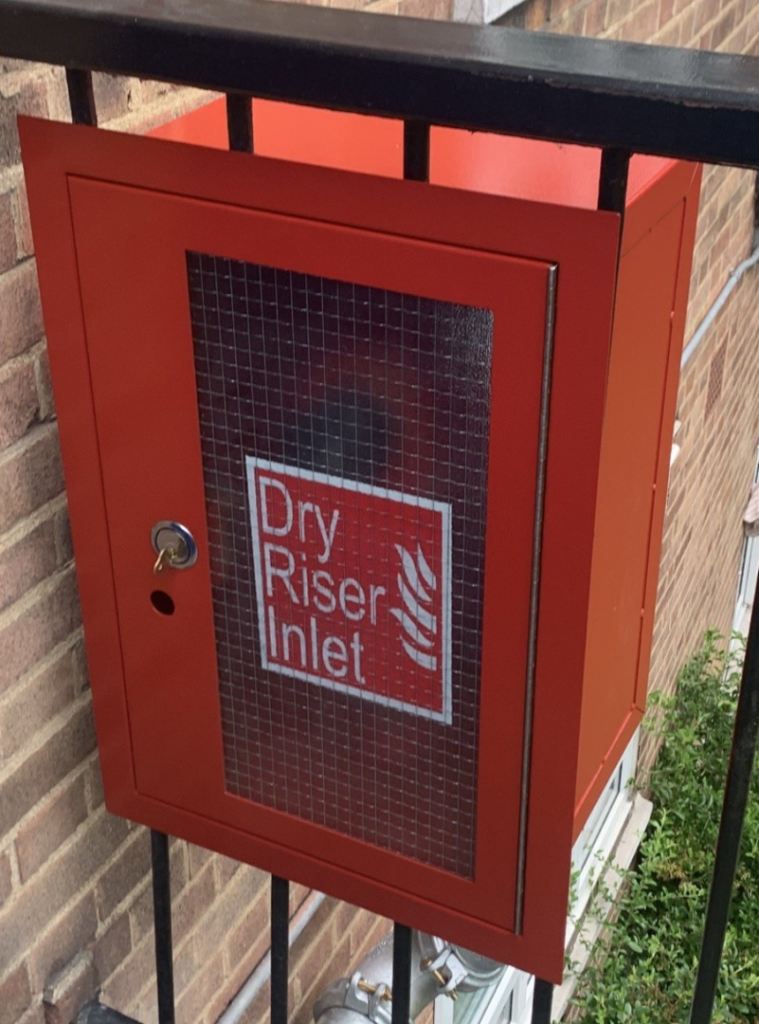
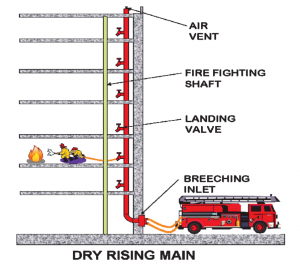
    Worth zooming in on the component itself. A dry riser is a fixed, empty pipe running vertically through a building — usually inside a staircase or service core — with an inlet at ground level and outlets on each floor. It carries no water day to day. In a fire, firefighters connect a pump to the ground-level inlet and charge the pipe from a hydrant, which is what lets them get water to an upper floor fast instead of dragging pressurised hoses up flight after flight. As FireTech Dry Risers explains, the system only proves itself the moment it’s actually charged with water — which is exactly why routine maintenance matters more than it looks like it does. A system that sits dry and untouched for months can develop a loose coupling, a stuck valve, or corrosion that no one notices until the pipe is finally pressurised in a real fire.

    How Dry Riser Works

    That’s the job of the fire safety vendor: not just showing up for the twice-yearly visual check and the annual pressure test, but treating each visit as the only chance to catch a fault before the system is needed for real. A proper service includes checking every joint, coupling, and landing valve, not just confirming the pipe holds pressure for the duration of the test.

    Where the digital record comes in

    This is the gap Basementgrid is built for. Not to stop a coupling from working loose — no software does that — but to make sure that when something fails anyway, the MCST isn’t reconstructing its maintenance history from memory or a folder of PDFs. A customised checklist for every fire protection asset on SCDF’s list, tied to the actual servicing and testing schedule, with vendor sign-off, photos, and timestamps logged against each task, means the MCST always has an answer ready: here’s when it was last serviced, here’s what was checked, here’s who did it.

    That record doesn’t prevent a fire. It’s what lets a council respond to an investigation with evidence instead of memory — and what lets an MCST move through exactly the kind of scrutiny Holland-Bukit Panjang Town Council is now facing, quickly and credibly.

    The same structure pays off outside a crisis, too. We’ve seen it firsthand with MCSTs losing thousands of dollars to inflated vendor quotations — the same lack of lead time and documentation that leaves a council exposed after an incident is what lets a vendor pad a quote once they’re already on site with no one left to say no to. Give the council early notice and a documented scope of work, and both problems shrink at once.

    Fix the process, not the people

    Council members are volunteers, not fire engineers, and they shouldn’t have to be. But when a system that was tested and passed still fails, the difference between a council that looks prepared and one that looks like it got lucky for years is whether the paper trail exists before the incident, not after it.

    Start building that record now. As we like to say at Basementgrid: fix the process, not the people.

  • AI Can’t Replace Skilled Trades: Why Plumbers and Electricians Are Winning the AI Boom

    AI Can’t Replace Skilled Trades: Why Plumbers and Electricians Are Winning the AI Boom

    Every week brings a new headline about AI eating white-collar jobs. What gets less attention is a simple, growing fact: AI can’t replace skilled trades. Electricians, plumbers, technicians, and the people who build and run the physical world are set to gain from the same shift that’s shrinking office jobs.

    Nvidia CEO Jensen Huang made this point clearly. Speaking about the scale of the AI buildout, he said the industry is going to need electricians, plumbers, carpenters, and technicians by the hundreds of thousands, and that the skilled trades segment of the economy is set for a boom that keeps doubling year after year. This isn’t a minor side note. Data centers don’t build or run themselves. Someone has to wire them, plumb them, cool them, and keep them running once the servers are switched on. That work sits squarely with people who trained with their hands, not people who trained on spreadsheets.

    Huang has also said this is simply one of the best times in history to start a company, and looking at where the demand is heading, it’s easy to see why. The infrastructure boom behind AI is creating real, durable, well-paid work at exactly the moment white-collar hiring is getting more cautious.

    Why white-collar roles are shrinking

    The uncomfortable part of this story is what’s happening on the other side. AI is genuinely changing how much headcount office work needs. Take a finance team crunching numbers for a monthly report. It used to take three people: one to pull the data, one to format it, one to check it for errors. AI collapses most of that into one person’s job. The model pulls the data, formats it, and increasingly self-corrects as it goes, so most of the remaining human time goes into review rather than production. That’s not a hypothetical. It’s already happening inside finance, ops, and admin teams everywhere, and the three-to-one compression isn’t going to reverse itself.

    This is the trend Palantir CEO Alex Karp has been blunt about. He’s argued there are really only two reliable ways to know you’ll have a future in this economy: have vocational training, or be neurodivergent. His point on vocational skills lines up with what Huang is describing. Trades are hard to automate because the work is physical, situational, and hands-on. His second point, about neurodivergence, comes from his own experience with dyslexia. He’s made the case that people who think differently, take unconventional paths, and solve problems in non-standard ways are the ones AI struggles to substitute for, because that kind of original thinking isn’t what these models are built to replicate.

    Why AI can’t replace skilled trades: the plumber example

    Here’s a simple example of why AI can’t replace skilled trades like this one. Say a pipe bursts inside a wall in an old building. A plumber shows up, and before touching a wrench, they’re reading the situation: how old is this building, what kind of piping was likely used at the time, is this a slow leak that’s been rotting the wall for months or a sudden failure, is the water pressure elsewhere in the unit suggesting a bigger problem upstream. They’re feeling for soft spots in the drywall, listening for water behind the tiles, and making judgment calls based on years of seeing buildings age in ways no manual fully captures.

    AI can't fix leaking pipe

    AI can tell you the standard steps to fix a burst pipe. It cannot climb into a crawl space, smell mould before you can see it, or decide on the spot that the “quick fix” will just cause a bigger leak two floors down next year. That kind of physical diagnosis, built on years of direct contact with real, messy, inconsistent buildings, is exactly the kind of work that resists automation. It’s not a coincidence that this is also the kind of work Huang and Karp are both pointing to.

    Where Basementgrid fits

    This is exactly the world Basementgrid is built for.

    We’re the single platform connecting building managers, MCST council members, and vendors around estate maintenance. If you’re new to why this space needs fixing in the first place, we’ve laid out the core problems in Fixing Strata Management in Singapore. For vendors, that means one verified profile that travels with them across every estate they work in, instead of starting from scratch and rebuilding trust with every new building manager or council they deal with. That verified track record becomes something they carry, not something they lose the moment they move to a new job or a new estate.

    That matters because it lets skilled vendors focus on what they’re actually good at: the trade itself. Basementgrid handles the layer around it, the scheduling, the communication with building managers, the job history, so vendors aren’t losing hours to admin they didn’t train for and don’t want to be doing. Good customer service becomes something the platform supports structurally, not something that depends entirely on one vendor’s memory or goodwill.

    On the other side, building managers and council members get to evaluate vendors based on real, verifiable track records instead of word of mouth or a single quote. When you’re deciding who gets a maintenance contract for your estate, seeing a vendor’s actual history of completed jobs, response times, and how past clients rated the work gives you a much stronger basis for that decision than a cold pitch ever could.

    The shift Huang and Karp are describing isn’t abstract. It’s already reshaping who gets hired, who gets paid well, and which skills hold their value. The bottom line is simple: AI can’t replace skilled trades, and the people doing that essential, hard-to-automate work need the infrastructure to be found, trusted, and paid fairly for it. That’s what Basementgrid exists to provide.

  • Vendor Quotation Trap Costing MCSTs Thousands on Water Tank Cleaning Compliance

    Vendor Quotation Trap Costing MCSTs Thousands on Water Tank Cleaning Compliance

    Vendors know MCSTs run out of time to negotiate water tank cleaning quotations before a certification deadline hits, and inflated quotations are the result. Here’s how the trap works, and how Basementgrid gives councils the lead time to avoid it.

    If you’re in strata management in Singapore, you already know that any building with a water tank needs annual tank washing, mandated by PUB, with a set of regulations attached to it. Simple enough on paper. In practice, it’s one of the clearest examples of how a lack of lead time costs MCSTs real money, and it plays out the same way in building after building.

    The stakes aren’t small, either. Failure to complete and submit the annual certification in a timely manner is an offence under the Public Utilities (Water Supply) Regulations. The penalty for late certification is a fine not exceeding $10,000 or imprisonment for a term not exceeding 12 months, or both. That’s the backdrop against which vendors negotiate, and it’s exactly why the pressure works.

    Here’s the playbook most plumbing companies run. The BM sends out a request for quotation. The vendor quotes low, based on the number and volume of tanks, because a low number is what gets the job in the first place. Then the technician shows up to do the initial check, and the quotation gets “updated.” Suddenly there are add-ons: change the bolts, fix the rusty lock, and so on, each priced well above what the work is actually worth. By the time the amended quote lands, it’s often double, sometimes quadruple, the original number. Even something as small as the lock replacement gets marked up, when going through a certified lock vendor directly would cost a fraction of what’s tacked onto the amended quote.

    On its own, that’s just an aggressive sales tactic, and a council with time on its hands can push back on it. They can ask for an itemized breakdown, query the pricing on individual add-ons, or simply tell the vendor to hold off while they get a second quote elsewhere. The tactic only works when the MCST has no room to negotiate.

    And that’s exactly the situation most MCSTs find themselves in. The worst part is what happens next. If the MCST is already close to the certification deadline, there’s no time to negotiate, and no time to get a second vendor to quote. So they pay. Not because the price is fair, but because they’ve run out of runway, and a fine for missing the deadline costs more than the inflated quote does.

    The MA isn’t much help here either. In practice, MAs tend to sit on these certification deadlines until the last moment, and the reason comes down to something almost administratively silly: the renewal notice from PUB goes to an email inbox that only the BM has access to. One person, one inbox, and everyone downstream, the MA, the council, the eventual vendor, is waiting on that one person to notice, forward, and act in time. If the BM is out sick, on leave, or simply buried under other requests that week, the notice sits there unread until it’s nearly too late to do anything about it.

    It’s also worth noting that PUB places the responsibility for maintaining and securing water service installations, tanks included, on MCSTs and building owners directly. Managing agents aren’t named in that responsibility at all. So when an MA treats the renewal deadline as someone else’s problem to track, that’s not just poor service, it’s a gap in exactly the place where the regulation says the MCST needs the most support.

    How Basementgrid Closes the Gap

    Once set up, Basementgrid handles this in three ways.

    Notifications go out early, and to more than one person. The system sends a reminder two months before certificate expiry, then follows up again as the deadline approaches if the certification still hasn’t been renewed. Both the BM and council members get it, not just whoever happens to have access to the inbox that day. Renewal stops being one person’s problem to remember, and MCSTs get back the negotiating time they’d otherwise lose. Two months is enough time to get competing quotes, compare them properly, and walk away from a vendor who tries the add-on trick. This isn’t limited to water tank cleaning either. Basementgrid tracks other recurring compliance items the same way, things like Lift Permit to Operate (PTO), Fire Certificate renewals, and MCST insurance policies, so nothing sits forgotten in a single inbox until it’s nearly overdue.

    The work itself gets documented, not just requested. Compliance work orders in Basementgrid can specify exactly what work is required, so vendors are held to the standard set by the relevant statutory body rather than whatever they decide to add on once they’re on site. These procedures are customizable to match different government bodies’ requirements, so the same structure works whether you’re tracking PUB tank washing, fire safety certification, or any other recurring statutory obligation. Once the scope is written down and agreed on up front, there’s a lot less room for a technician to “discover” extra work mid-job.

    Every action is timestamped, so accountability doesn’t depend on memory. If work gets delayed and a fine follows, the activity log lets you trace exactly where the delay happened and who’s responsible for it. Comments can be added along the way as evidence that reminders were sent and deadlines were flagged. “I forgot” or “I didn’t know” stops being a usable excuse, because there’s a record showing otherwise.

    None of this stops a vendor from trying to pad a quote. What it does is take away the one thing that makes the tactic work: a council with no time left to say no. Give MCSTs that time back, and the negotiation looks a lot more even.

    This is one small piece of a much bigger pattern in how strata management runs in Singapore. If you want the fuller picture of what’s broken and why, take a look at Fixing Strata Management in Singapore.

  • The Hidden Cost of Termite Infestation in Singapore Condos

    The Hidden Cost of Termite Infestation in Singapore Condos

    The termite infestation problem at The Tre Ver is a textbook case of what happens when DLP inspections and rectification works aren’t followed through properly.

    According to the Straits Times report, more than 50 units at The Tre Ver have raised termite complaints since December 2022, based on a WhatsApp group chat among affected owners. The condo obtained its TOP in late 2022, which means these complaints started almost immediately after handover, squarely within the window where the Defects Liability Period should have caught this. Yet UOL has only confirmed around 15 affected units to date, and both the developer and the MCST declined to disclose the full number affected. That gap between 50-plus complaints and 15 acknowledged cases is itself worth sitting with. Either the reports weren’t tracked consistently, or they were tracked but never escalated with enough urgency. Drywood termite colonies can also go undetected for years before the damage surfaces, which makes early, consistent logging even more important, not less.

    Whose Property Is It, Really?

    This is where the ownership question gets murky. Kitchen cabinets and other interior fittings are typically not common property, so an MCST or MA isn’t automatically on the hook for damage inside a unit. That’s often used as the reason a case gets closed at the owner’s expense. But a recent case shows that reasoning doesn’t always hold. Freesia Woods MCST was recently ordered by the courts to compensate a couple whose kitchen cabinets, sink, and countertop were damaged by termites, after the court found the infestation originated from common property soil that the MCST had failed to keep termite-free. The damages awarded were S$10,978, but the MCST was also hit with over S$42,750 in legal costs, bringing the total payout to more than S$53,000. In other words, the actual repair cost was a fraction of what the case ended up costing the MCST once it went to litigation. That’s the real lesson here: it’s rarely the termites that bankrupt an MCST, it’s the legal and reputational cost of not having a clear paper trail on when the issue was first flagged and what was done about it.

    Legal and reputational cost of not having a clear paper trail

    Council members are volunteers, and most don’t have the bandwidth to chase every unit’s complaint history or verify whether their MA actually followed up. That’s not a criticism of any individual council or MA, it’s just the reality of how strata management is structured today. But it means that when something like this goes unresolved for years, the MCST as a whole ends up carrying the cost, financial and otherwise, of a process breakdown that no single person was positioned to catch. This is exactly the gap Basementgrid is built to close: not replacing the BM or MA, but making sure complaints, inspections, and follow-ups are visible to more than just the person handling the case, so an issue like this can’t quietly sit for years before anyone in leadership notices.

    Construction Gets Graded. Management Doesn’t.

    There’s also a broader industry signal worth pointing out. BCA has run CONQUAS since 1989 to assess construction workmanship, things like water seepage and tile defects, and grades developers and builders from Band 1 (very low incidence of major defects) down to Band 6. Construction quality has a public benchmark. Managing agent performance doesn’t, at least not yet. As termite and maintenance disputes keep surfacing, it wouldn’t be surprising if BCA or another body eventually moves toward some form of MA accountability framework. In the meantime, it’s a good practice for MA firms to get ahead of this themselves, using a system that lets management track how their building managers are performing across sites and step in before a case escalates.

    The Underlying Reality

    It’s not really a secret that managing agent fees are competitive, and that a lot of building managers are non-specialists, often retirees, rather than trained facilities professionals. None of that is a knock on the people doing the job. It’s exactly why a system that standardizes how issues get logged, escalated, and tracked matters as much for protecting the MA’s own reputation as it does for the MCST’s.

  • Fixing Broken Strata Management: Why Basementgrid Exists

    Fixing Broken Strata Management: Why Basementgrid Exists

    Spend enough time around Singapore’s strata management scene and a pattern shows up everywhere, in estate after estate, regardless of who’s running it.

    Take the Building Manager. On paper, the job looks simple: keep the estate running, get repairs done, report back. In practice, it isn’t. A good chunk of a BM’s time, often the majority, goes into relationship management rather than maintenance management — keeping the council happy, smoothing over egos, responding to whatever surfaced in the WhatsApp group that day. The work residents actually notice keeps getting pushed down the list.

    Part of the reason is that there’s often no real process behind the job. No defined system for how a repair gets requested, approved, and closed out. So whoever is physically on-site ends up calling the shots by default — dealing with leaks, lift breakdowns, and tenant complaints at 7pm on a Friday, making decisions on the fly because someone has to.

    Then there’s the council. Well-meaning owners volunteering their evenings, but their main point of engagement is usually questioning the repair bill after it’s already been paid. “Why did this cost so much?” “Did we need this vendor?” Fair questions — except most council members aren’t maintenance experts. They can’t easily tell if a quote is fair, if an invoice matches the scope of work, or if a vendor is even legitimate. So scrutiny lands on cost, after the fact, instead of on process, before the fact.

    Nobody in this setup is doing anything wrong. The BM is doing their best under pressure. The council is doing what they believe their duty requires. But with no structure in place, every decision runs on memory, trust, and whoever picks up their phone first.

    That’s not a people problem. It’s a systems problem. That was the first reason Basementgrid needed to exist.

    The software that already exists wasn’t built for this

    The natural next step was to look for software that solves it. CMMS tools exist, just not for this world. Almost all of them are built for an internal maintenance team — employed by the building, using the same system daily because they have no choice. Log a ticket, assign an in-house technician, close it out. That works fine when you’re giving orders to your own staff.

    And to be clear, this isn’t a gap that apps like iCondo or iPlusLiving fill either. Those platforms are built for communal living — facility bookings, visitor management, resident announcements, the social side of condo life. Useful, but aimed at residents, not at the operational backbone of how repairs get requested, approved, and closed out.

    But that isn’t how strata management works. An MCST doesn’t run on an internal crew — it runs on external vendors: plumbers, electricians, lift technicians, cleaners, landscapers, dozens of contractors moving between many buildings, not just one. The MA’s real job isn’t fixing things. It’s coordinating the vendors who do.

    That’s where every existing CMMS falls apart. You can’t force a vendor to log into your system. They have no reason to. They’re not your employee — they’re doing jobs for twenty other buildings this week, each possibly running a different system, if any. Ask a vendor to create an account and update ticket statuses for a job worth a few hundred dollars, and the answer is a WhatsApp message instead. Every time.

    So estates end up back where they started: coordinating over calls, texts, and memory — the same chaos as before, except now there’s also an expensive piece of software nobody uses sitting in the background.

    That was the second reason Basementgrid was founded. Not “another CMMS,” but one built around the reality that MCSTs run on vendors, not employees — where getting vendors to actually participate is the core design problem, not an afterthought.

    The part that only shows up over years

    The third issue takes longer to see, because it doesn’t show up in a single site visit — it shows up over years. Managing Agents change, a lot. And the new one is often a company already familiar, recycled from another estate down the road.

    It’s musical chairs. A new MA comes in, there’s a fresh start for a while, then a year or two later they’re let go too, and the whole cycle resets from zero: onboarding, learning the estate, rebuilding vendor relationships.

    Most of the time, MAs aren’t let go over maintenance competence. It comes down to the Building Manager’s relationship with the council — and council members, however well-intentioned, usually aren’t professionals in this space. They’re volunteers with day jobs. So the relationship becomes the deciding factor, not the work. A BM who is well-liked survives. A BM who is competent but blunt, or slow to reply at 9pm, doesn’t. Maintenance work stalls not because it can’t get done, but because the relationship managing it keeps falling apart.

    That’s not to say every BM is blameless either. Plenty aren’t well-equipped for the job. It’s something of an open secret that many BMs are retirees, hired to fill a headcount rather than for hands-on experience. So you get a BM who isn’t strong on process, managing a relationship with a council that isn’t strong on maintenance, with nothing structural holding the estate steady when the relationship sours.

    That’s the third reason Basementgrid was founded. An estate’s operational history shouldn’t live and die with whichever MA happens to be in the chair this year. The work orders, vendor records, approval trail, maintenance history — that should belong to the building, not to whichever company or BM currently holds the relationship together. When the MA changes, and it will, the estate shouldn’t have to start from zero.

    (More to come — this is where Basementgrid’s story really begins.)